
Tony Melia
“We are the ‘pot of gold at the end of the rainbow,’ rainbow having a double meaning.”
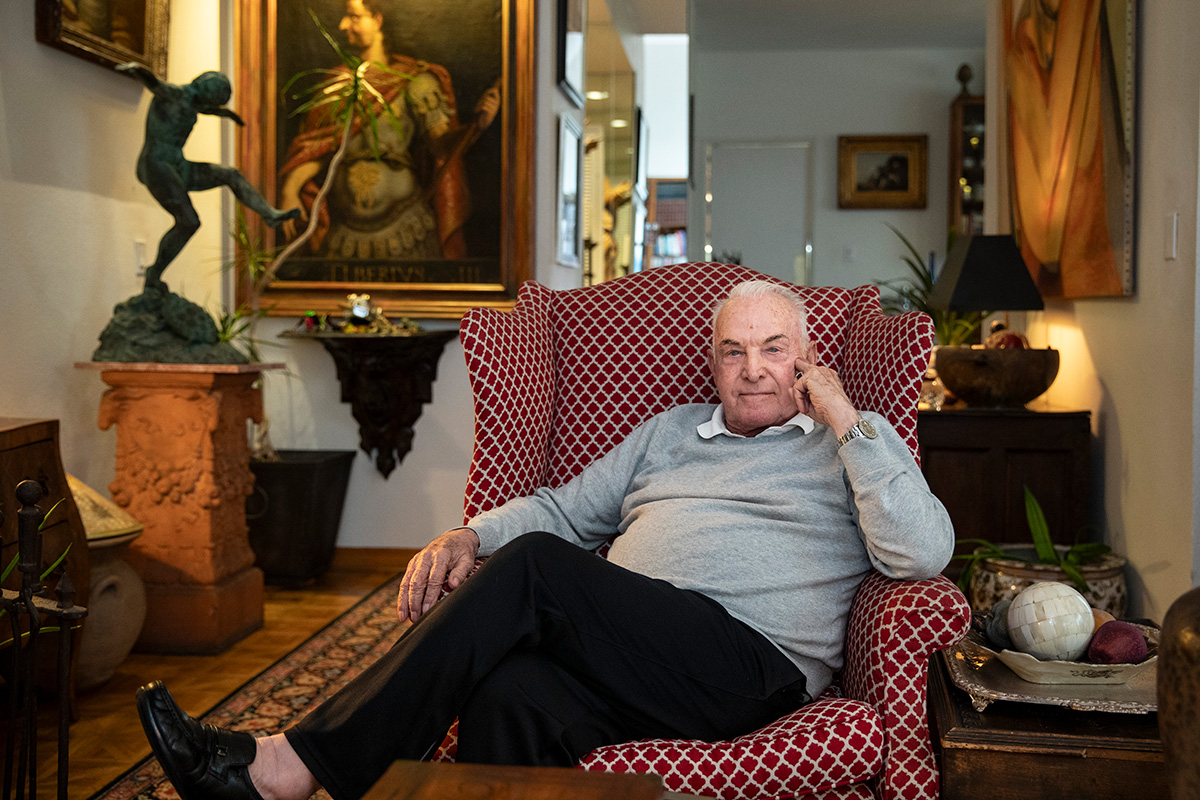
I was raised on a farm in Nebraska as one of twelve children. One year into college at Nebraska University, I decided to take advantage of the GI Bill and enlist in the Korean War, which was coming to an end. I didn’t serve in Korea, thank you baby Jesus, but I did see a lot of Europe before going back to Nebraska to finish college. I left for California the day I finished my last college test. Why? Have you ever been to Nebraska in the wintertime?
At the time, in the late ’50s, I knew one person in California—a clothing designer I met at a party in Omaha who lived in West Hollywood. He invited me to stay with him at what’s today the Grafton Hotel. When I got to West Hollywood, the streetcar was still operating down Santa Monica Boulevard and there were beatniks, pre-hippies, on the Sunset Strip. After staying with him for a few days, I moved to the YMCA in Hollywood, then to Silver Lake. After seeing how difficult it was for gay men in the City of Los Angeles—harassment by neighbors, raids by the Los Angeles Police Department (LAPD)—I wanted to return to unincorporated West Hollywood where the sheriff’s deputies didn’t give a rat’s ass about gay men, and there was great nightlife up on the Sunset Strip. I’d go to restaurants like La Rue, Scandia, and Frascati’s. And clubs like Crescendo, Interlude, Mocambo, and Trocadero. I remember seeing Dinah Washington at the Trocadero, which was just insanely wonderful, and Frances Faye at the Crescendo. Not much is around anymore from those years. I think Las Vegas took a lot of the luster away from those places and they closed down.
In college, I thought I was going to be the new Clark Gable, but I started working in the insurance industry and found I was good at it. I worried that if people at work knew I lived in West Hollywood, they’d assume I was gay and I might get fired, as that happened in those days. So in about 1968, I started my own insurance company in the newly opened 9000 Sunset building. My first employee was a young woman who spent her youth in the Japanese internment camps. The top floor of that building had the restaurant Scam with a view of everything. It was owned by Steve Crane who was Lana Turner’s husband. A&M Records had offices there. On the first floor, there was a movie theater called Grenada.
After a few years on my own, I made enough money then to buy a brand-new house up on Sunset Plaza. I paid $36,000 for it and sold it for $76,000. I used that money to buy a small apartment building on Carol Drive [in West Hollywood]. My neighbors were people by the name of Wilson. Now, the Wilson’s childhood home was the building that eventually became Spago’s, which had also been the infamous Café Gala—a gay/straight mecca—before it became the Armenian restaurant, Kavkaz. Café Gala was run by a guy named Johnny Walsh. It had a wealthy contessa who funded it. It was a safe place for wealthy gay celebrities from the movie industry to go, as well as people like Judy Garland and Cole Porter. I got to know the bartender there, Scotty Bowers, who gained a reputation as a procurer of boys for men and women. I’d see Scotty at every wealthy gay Christmas, Thanksgiving, Easter, or whatever party. I was told that he even got a man for the Duchess of Windsor and a man for the Duke of Windsor when they visited here.
By my thirties, in the 1960s, I was going to these gay bridge parties north of Sunset. George Cukor—who lost the job directing Gone with the Wind because Clark Gable didn’t want any gay “poofter” directing him—would play bridge with us, as did Rock Hudson. We called Rock “Roy”—his real name. I became Rock’s lover and then I moved in with him. But Roy was very closeted and when he thought I told his mom he was gay, the relationship soon ended. His mother knew he was gay. I knew people in Iowa and Illinois, who knew he was gay. But Rock thought otherwise.
Around this time, there was talk of a subway coming through West Hollywood. Beverly Hills blocked the subway, which led to plans to have an auto tunnel under Laurel Canyon—like what Elon Musk is suggesting today. By the ’70s, I started to become more and more active in the West Hollywood community. I got involved with Saint Victor’s Church and was one of the readers at mass. I fought the Briggs Initiative [the California ballot proposition that would have banned gays and lesbians from working in schools] and before that the Anita Bryant situation [the anti-LGBTQ rights crusader from the ’70s]. I got involved in a political group of rather wealthy gay men and lesbians that developed into MECLA [Municipal Elections Committee of Los Angeles]. I was the president and one of the founders of BAPA [Business and Professional Association], a business group of gays and lesbians. We had a monthly meeting at Gene Autry’s hotel [Hotel Continental], which became the Continental Hyatt House in West Hollywood, and is now the Andaz hotel. At the height of the AIDS crisis in the ’80s, I had Dr. [Michael] Gottlieb [American physician and immunologist who was pivotal in identifying and reporting the first cases of AIDS in 1981] come to BAPA to talk about his journey to find the AIDS virus. The lesbians didn’t like this kind of “dinner talk,” but I thought that everyone should be concerned about educating their employees to have safe sex.
When Cityhood got on the ballot in 1984, I was the president of the West Hollywood Chamber of Commerce. I thought we should endorse Cityhood, but I had to deal with the Montgomery family who owned property on the Strip and were avid anti-Cityhood people. I argued that we deserved to be our own city because it was very obvious that all our money was going elsewhere in L.A. County. Before we became our own city, we just didn’t have control over our own success or fixing things like the potholes and wires up and down Santa Monica Boulevard.
I remember being at the very first City Council meeting and feeling very proud because we had taken the reigns from L.A. County. I was very pleased that the City Council said they’d take down that goddamn “FAGOTS — STAY OUT” [sic] sign at Barney’s Beanery. Rent control was a hard issue for me, but I thought it was workable. I saw older buildings were being scooped up and made into condos, and those little houses down Melrose Boulevard that were actually living spaces became decorator showrooms and antique dealers. I sold my property on Carol Drive because when the City made us roll back rents, I knew I’d never recoup my investment. I wanted to cut my losses.
As the City started forming, I got appointed to the City’s Insurance Committee to help find a company to insure the City. I was still president of the Chamber of Commerce, and I played a big role in helping the City Council and businesses to work together to give West Hollywood an improved look. We widened the sidewalks and planted trees, but got all kinds of pushback from businesses because they said trees blocked signage. I told them to grow up—that these improvements were good for business. Councilmember Helen Albert was very staunch about these improvements, and I loved her for this. We were able to beautify the median strip, but only after suing Caltrans [who owned it then] for deferred maintenance. Eventually, the state transferred the median strip to the City. I remember at one point, the chamber wanted to get rid of all those damn signs posted on utility poles advertising concerts on the Strip. I collected a whole bunch of them and took them to the City Council and said, “That’s what we face.” Where L.A. County had no code enforcement, the City implemented code enforcement that seemed brutal.
In the early days, some of the councilmembers and City employees treated businesses like errant children. They didn’t seem to understand that the City’s money came from us, the business community. I worked very hard to get the City Council to understand this, and by the late 1980s, it was clear that Council members John Heilman and Abbe Land understood the contribution the business community made to the City. They were very probusiness, and community-oriented, and progressive at the same time.
One of the things I’m most proud of is that after Cityhood, I took the chamber out of bankruptcy and brought it back to life. For a while, I ran the chamber out of my insurance office at 1017 N. La Cienega. I had a switchboard installed with two lines—one for the chamber and the other for my insurance business. My switchboard operator knew when to say, “West Hollywood Chamber of Commerce, may I help you?” I had some ideas of how to build up membership. I got very friendly with the local newspaper at the time, The Post, and they published pictures of chamber events, so we looked humongous compared to the 170 members we were back then.
I finally brought Chamber membership up to 400 members. At that time, West Hollywood was known as the gay city—and for Boystown—but that wasn’t who we were. Then City Manager Paul Brotzman had the idea to start a marketing corporation, funded partially through the transient occupancy tax [the hotel bed tax]. I became president of the West Hollywood Marketing Corporation, and realtor Ron Kates and George Rosenthal, who owns Sunset Marquis Hotel, were board members. The Marketing Corporation, which eventually became Visit West Hollywood, was like the public relations firm for the City.
At the beginning of the AIDS crisis, after one of the news stations said, “Don’t drop the soap in West Hollywood,” we decided we needed to show outsiders what was really enticing about being in West Hollywood. I knew from my insurance work that if you were in West Hollywood, insurance companies were kind of closing the doors on selling you health insurance. So, Ron Kates came up with the term Creative City to show that West Hollywood was more than a gay city but home to a lot of record companies, a lot of design companies, builders, artists, and art galleries. I remember at one time, a prominent gay publication, the Advocate Magazine, accused us of sanitizing the City. I hauled my butt over there to say, “West Hollywood is not even fifty percent gay, we’re a lot more than gay.” Sure, if you say West Hollywood any place in the world, the gay community says, “Oh that’s the gay center of Los Angeles.” Sure, our gay pride parade is the third largest parade in L.A. County, after the Rose Parade and the Hollywood [Christmas] Parade. But if you talk about the rock and roll clubs on the Sunset Strip, the design industry, and the music industry for sure, West Hollywood is the place. The 9000 Sunset building has a lot of agents and record companies in it. David Geffen [the founder of Geffen Records and cofounder of DreamWorks] wanted to build at the corner of Doheny and Sunset. When I heard that, I thought antidevelopment activist Jeanne Dobrin was going to have a coronary.
I have encountered many colorful characters here, like Jeanne Dobrin, and many interesting stories. Jeanne was a Public Facilities commissioner and wanted the hedge at Saint Victor’s Church to be taken down because she remembered that somebody somewhere jumped out of it to attack people. Well, that’s like what President Trump is saying—we need a wall across the southern border. Then there was this guy who went around finding businesses that were not on our tax rolls. I remember him arguing about the Hard Rock Cafe in the Beverly Center because part of it falls in West Hollywood but because the cash register is in Los Angeles, the taxes went to the City of Los Angeles. One of the crazier stories is from 1990 where a guy from Texas who had murdered a student made his way to the Mondrian Hotel to hide out. When the police knocked on the hotel door, he and his friend both jumped out of the window of the building and killed themselves. I no more believe the story that Alfredo De La Vega, who owned the La Fontaine apartments on Crescent Heights and Fountain, killed himself than I can fly. If you’re going to kill yourself, why would you shoot yourself three times? This was a few years after Cityhood, and I think no one wanted to publicize a murder in West Hollywood—a suicide was sufficient.
I was approached several times to run for City Council, but I had too much guff as the president of the Chamber of Commerce to consider that. I did make a difference in the early years of the City. I got the chamber’s Lifetime Achievement Award twice. I’m involved less in the City lately, but I did speak at City Council against the fur ban that Ed Buck proposed. I thought it was total insanity. I told the City Council, “Of all the things we could be against and prohibit, why not cigarettes? They kill more people than fur.”
I said, “Do you have any idea what’s happening in the chocolate business with nine-year-old children working at cocoa farms to give us chocolate?” I’m quoted as saying, and I did say it, that “We are the pot of gold at the end of the rainbow,” rainbow having a double meaning. We were, for the gay community, the pot of gold, but also for a lot of others in West Hollywood too. West Hollywood is eclectic—neither one thing nor another. I extol its beauty and wonders. I love West Hollywood.

