
Steve Schulte
“I may have moved to West Hollywood because I wanted to be a gay elected official, but the City got to my heart.”
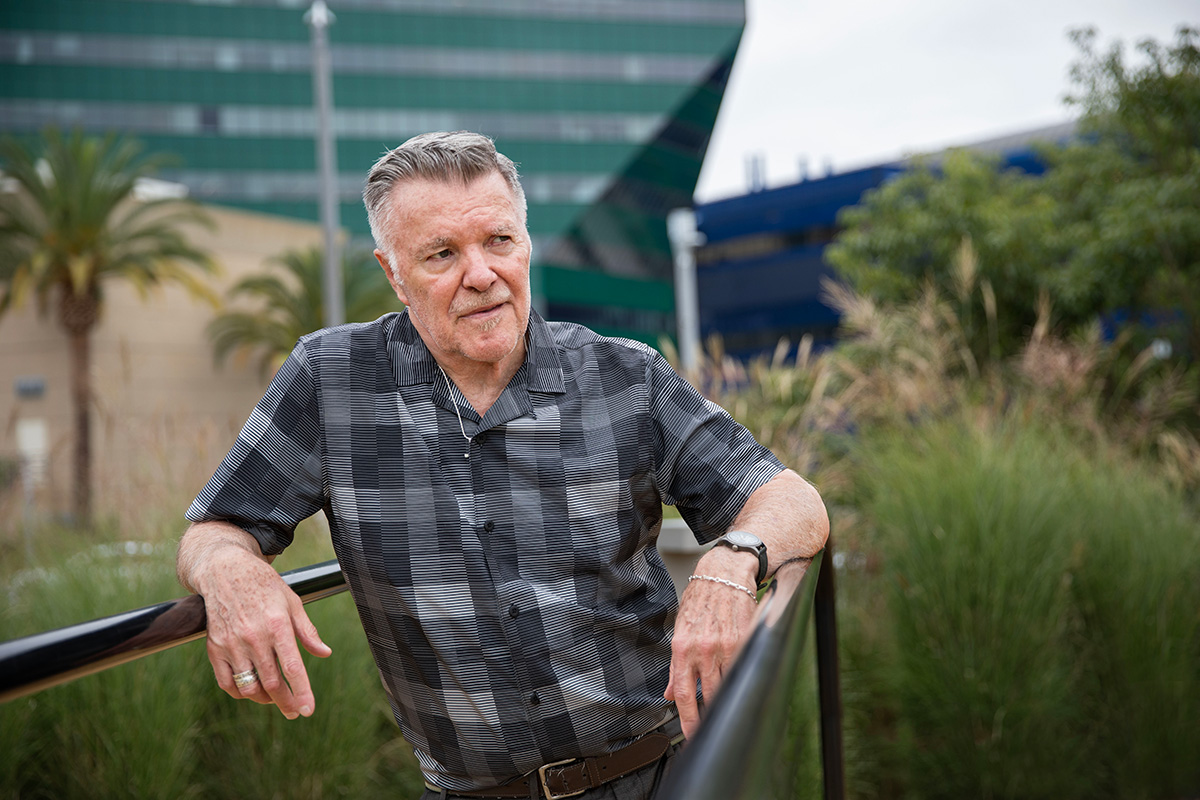
Being elected as a gay person was a fantasy of mine. My few role models were the openly gay elected officials from the late 1970s. There was Elaine Noble in the Massachusetts House of Representatives, Allan Spear and Karen Clark in the Minnesota legislature, and Harvey Milk in the San Francisco Board of Supervisors.
So, in 1983, I did one of the stupidest things I’ve ever done—I ran against my former boss, Los Angeles Councilmember Peggy Stevenson, because she represented one of the few areas in the City of Los Angeles that was liberal enough for a gay person to win. Or at least I thought. I lost the race.
But with the West Hollywood Cityhood election just minutes away, which included electing its first City Council, I decided to meet with my mentors, Rand Schrader and Sheldon Andelson, to ask them if I should move to West Hollywood and run for City Council. They said I needed to make the move, and I did. I already had some notoriety in the gay community because I was the current executive director of the Gay and Lesbian Community Services Center [now the Los Angeles LGBT Center], and West Hollywood was thirty percent gay. I was very, very laser-focused in those days, and I told myself I had to win.
I didn’t know the politics of West Hollywood before I moved here. I learned about the Cityhood issues in the gay publications and, to some extent, the Metro section in the Los Angeles Times. I was smart enough to go meet Ron Stone [known as the Father of Cityhood] really quickly, but I didn’t really know about the Coalition for Economic Survival (CES) at first. I thought the group was intense about their agenda and it never seemed open to me. But I realized they were a force to be reckoned with, and I became friends with CES activist Jacqueline Balogh who educated me on their issues.
With forty candidates running for five City Council seats, there was a lot of crazy during the campaign. I remember a candidate forum where it became clear that some candidates were honestly not cut out to do this job. But there were good candidates like Ron Stone, who put out a document that was called something like “100 Ideas for Cityhood.” I got to know Alan Viterbi pretty well, and he proposed that we team up and run some kind of joint campaign. We decided it was best for both of us if we didn’t.
One candidate, Art Guerrero, hated me so much that he sent out a mailer against me that said, “Which Steve Schulte are you voting for?” One side of the mailer had a photo of me wearing a shirt and tie as the executive director of the Gay and Lesbian Center. The other side had a photo of me buck naked, taken from the gay publication Colt that I had modeled for. I think maybe four or five women called the campaign office after that mailer, and they said it was horrible, but they were still going to vote for me. Well, the joke was on me. When I became a Colt model, after being recruited in 1977 at the West Hollywood Safeway grocery store [now Pavilions supermarket], I knew I wanted to run for office one day. But I didn’t think anything of it—it was a way to make some extra money, and gay modeling was currency in the gay community. But all during the campaign, the L.A. Times reporter, Stephen Braun, kept referring to me as a former Colt model. The night I was elected, I asked Braun, “When are you going to stop calling me that?”
He said, “Tonight.”
I barely won a seat on the City Council. I came in fifth, just barely before CES’s Doug Routh. I would've been shattered if I hadn’t won. Helen Albert and I got the short end of the stick—our first term was only two years because the City Council had to stagger re-election years so that everyone wouldn’t be up for election at once.
The night of our very first City Council meeting was very festive, absolutely emotional. We [councilmembers] were all on stage at Fiesta Hall in Plummer Park. The room was packed. We had to introduce ourselves and say something. I said, “Part of our victory on the City Council is for Harvey Milk.”
From the beginning, and for the first year of the City, there were so many policy issues to deal with. As someone who was always very idealistic about urban improvement—I’d taught fourth and sixth grade in Newark years before and ran a community development agency in Iowa, where I was from—I was very focused on establishing a certain kind of ethos for the City. I wanted to be accessible to residents. I liked the idea of being able to redesign Santa Monica Boulevard and have the kind of businesses we wanted. Councilmember Helen Albert asked me to work with her on promoting public art in the City to set the tone for it and give it legitimacy. I had a certain expectation of our staff, and I helped bring on Jodi Curlee as the City’s founding Social Services manager. She really made sure that we had a good funding process for social services, which was important to everyone on the City Council.
Developing our rent control law was absolutely consuming. It was a whole education for me, very technical. We had to discuss stuff I’d never heard of, or thought about, before. Like, should we allow condo conversions or not?
As a new city, West Hollywood was seen as a sort of shiny object, on the one hand, and on the other hand, an oddly shaped ornament, right? People didn’t quite know what to do with us, partly because we had a gay-majority City Council but also because of the sort of wacky ideas that people thought came out of us—like cancelling Christmas in the City, for example. Two or three months after we had hired our temporary city manager, Fred Bien, he said, “You people are out of control.”
But I am really proud of the ordinances we passed early on. Valerie Terrigno and I coauthored our domestic partnership ordinance. The City Council saw this as a really important basic right for both seniors, who depended on their roommates like spouses do, and for the gay community, many of whom had partners dying of AIDS but couldn’t even visit them in the hospital or have access to bank accounts to manage their finances. When we passed the domestic partnership ordinance in 1985, this was supposed to be the top of the mountain for the gay community. Nobody was imagining gay marriage at the time. In the first months of the City, we also passed a boycott against South Africa and an antidiscrimination ordinance. I remember there was a hair salon called Japps, and the name was so offensive to people in the City—it seemed so anti-Asian—that the City Council held a hearing about whether the name constituted a hate crime. After that, the owners changed the name.
It was a process for the Los Angeles County Sheriff’s Department contract to come into our hands, and I had a hand in negotiating it. We wanted them to hire “out” gay and lesbian sheriff’s deputies, and the Sheriff’s Department fought us on that. We wanted the department to do sensitivity training with the officers, and there was a lot of hostility among the deputies who attended those trainings. I think, also, they didn’t like that West Hollywood was so progressive. At the same time, several people in the gay community wanted us to have our own gay police department. I always thought that was for Kafka. I mean, why would we let the Los Angeles County Sheriff’s Department off the hook for not hiring gays and lesbians? What better way to get them to do that than to have a contract with them, right? Also, how could the City afford this? I remember very well how at one public meeting, homeowner activist Joyce Hundal accused me of fomenting the idea for a gay police department. I don't think I was civil in my response to her. Anybody who knew me, knew that wasn't true.
A few years later, my friend Ruth Williams and I proposed forming a West Hollywood Public Safety Commission to reinforce civilian oversight of the Sheriff’s Department. Everyone supported the idea, and it helped monitor the contract with the Sheriff’s Department and improve relations with the community.
When the idea was introduced in the late 1980s to take away green space in West Hollywood Park for a civic center, I was concerned. I didn’t like the idea of losing any of our limited parkland. After seeing the proposed design, which seemed to carve up the park like a jigsaw puzzle, I spearheaded the Save Our Parks campaign, Measure B, along with Ruth Williams, Bud Kopps, Gerda Spiegler, Steve Martin, and Jeanne Dobrin. Despite the odds, Measure B won in November 1989—we saved the park.
When I became mayor in 1986—the City Council rotates every year—I made Elvira [the horror hostess actress] honorary mayor during our infamous Halloween celebration. I was also invited to speak around the country as a gay mayor. People would ask why we’re the “gay city” and I’d say, “Well, interior design is a major industry here, and the community is helping the Sheriff’s Department design their uniforms.”
I enjoyed being on City Council from the beginning. But after a while, it was hard to keep up with City Council work and keep up with my full-time consulting job to help organize conferences around the country to educate doctors on HIV/AIDS. It got harder when councilmembers became competitive about who your friends were, where you raised money from, all that sort of stuff. I got tired of the games and decided not to run for reelection in 1990.
During my two terms on City Council, the City’s revenue growth was phenomenal. I think we were up to a $30 million budget. I’m proud of that. One of my biggest regrets on City Council was not allowing music executive David Geffen to build his six-story office building in West Hollywood because it was above our General Plan height limit. It was a stupid decision because Geffen was, and is, a major player in the entertainment industry, and it would've been good for West Hollywood.
I may have moved to West Hollywood because I wanted to be a gay elected official, but the City got to my heart. This 1.9-square-mile, gun-shaped oasis in the middle of urban chaos became symbolically very important—not just for being a gay city, but for its urban culture that had an international resonance.

