
Jeffrey Prang
“There were some real flamethrowers back then.”
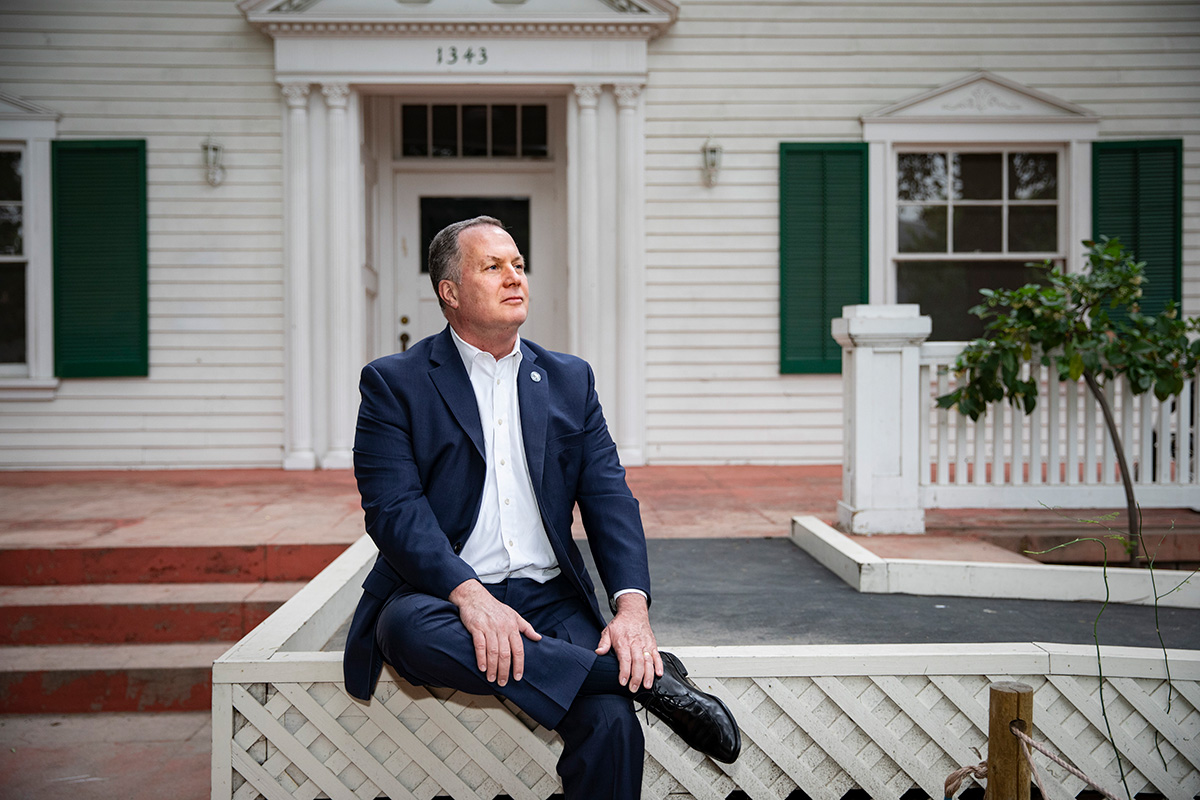
I was always interested in politics since I was a nerdy little kid in Warren, Michigan. I even ran for City Council between my junior and senior years at Michigan State College. I got clobbered but stayed active in politics.
When I was just out of college in 1984, I was also coming out as a gay man, and I saw the news stories about Cityhood and found it to be intriguing. At the time, I was working for a Japanese trading company, but there was really no LGBT activism in those days in Michigan, and there did not seem to be a pathway to integrate who I was becoming socially with the rest of my life. I wanted to immerse myself in a community and be able to be free. In August 1987, I packed up my car and arrived in West Hollywood. In my early days in West Hollywood, somebody told me, “In West Hollywood, if you don't belong to at least two gyms, you're nobody.”
Two years after moving to West Hollywood, I was really craving to get back involved in political activity, and my friend Charles Perez said, “We should join the West Hollywood Democratic Club.” So not knowing anything about West Hollywood politics, we both agreed to go one night. He bailed on me, but I went. I think two or three meetings later, they elected me vice president. I got more involved in our city’s politics in 1989 after a phone banker called me about Measure C, a ballot measure to build a civic center in West Hollywood Park. I thought this was the dumbest thing I had ever heard: You can’t take a big park and put a building in it without losing open space. So I got involved in the opposing ballot measure, Measure B, Save Our Parks, to stop the development of the civic center. Its supporters, Steve Martin, Bud Kopps, etcetera, became my first political friends in the City.
The next year, in 1990, Steve Martin was running for City Council, and he hired me as his day-to-day campaign coordinator. He won. We were even roommates for a while, and in 1994, Councilmember Steve Martin appointed me to the Rent Stabilization Commission. At the time, I was press deputy to Los Angeles City Council member Ruth Galanter, who was very progressive, and great on LGBT issues and environmental issues.
Those things gave me credibility, prestige. I have some regrets about that period of time because I was decidedly on a side I shouldn’t have been on in West Hollywood, in regard to development issues—which was in opposition to the City Council majority at the time of John Heilman, Abbe Land, Helen Albert, Babette Lange, and Sal Guarriello. I view the issue totally different now than I did in those days.
In March 1997, Steve Martin encouraged me to run for City Council. There were two seats up in that election: Paul Koretz’s and Abbe Land’s, which was an open seat since she decided not to run. By this point, I had some standing in the community and Steve got his whole coalition behind me. I can’t even remember who they all were, but there was Ruth Williams and Gerda Spiegler. The Coalition for Economic Survival (CES) didn’t support me then because they were suspicious of me because Steve Martin was my ally, and I was suspicious of them because of the divisions in the community at the time. I used to joke that there are two political parties in West Hollywood: there’s the pro-rent control party and the other pro-rent control party. And one pro-rent control party says that the other pro-rent control party is anti-rent control. I knew nothing about rent control before I moved to West Hollywood, but I supported it because I believe that there’s a role for government to play in helping people’s lives and in checking the excesses of capitalism.
Anyway, nobody thought I was going to win that race because John Duran was also running and he was a giant—the president of LIFE AIDS (Lobby for Individual Freedom and Equality) and one of the most well-known LGBT leaders in the state—and he had the backing of Councilmembers John Heilman and Abbe Land, and CES. I got elected simply because I worked harder and smarter than John Duran. He talked about his statewide and national advocacy on HIV and LGBT rights. I talked about traffic and parking, and development. I precinct walked every single door. I came home from work, and I went precinct walking for a couple of hours until it got dark. I walked eight hours a day on Saturdays and Sundays. I won the election. I think if Abbe Land had run for reelection, she would have hammered me.
When I first got on the City Council, I came into a very political environment. There were some real flamethrowers back then. For example, I thought rent control should have been a unifying issue on City Council, but it wasn’t. I think West Hollywood and other cities with the strongest rent control laws—like Berkeley and Santa Monica—have some responsibility to bear for the weakening of rent control with Costa-Hawkins Rental Housing Act. They demanded the whole pie at a time the Assembly was Republican-controlled. Any time you demand the whole pie when you’re capable of getting a majority of it, you should take the majority of it.
But despite differences on the council, I was able to redefine myself as a consensus maker, a problem solver. What I think I did better than anything else was the way that I governed. I created a constituent newsletter to keep people informed. People make better decisions if they’re informed. I was really proud that I was kind of a detail guy. A lot of the things we do in government are about the details on people’s streets—tree trimming, a response to a homeless issue, or a pothole. I always liked to tell people, “You know you’re entering West Hollywood when the potholes stop.” Parking and infrastructure were important to me. By the time I was up for reelection in 2001, the council had added almost 2,000 new parking spaces.
As a councilmember, I was part of the people who were charged with paying attention to what was important in West Hollywood, trying to preserve it, expand it, and make it available for others— both within our borders and beyond. And we [City Council] listened to people and included people—like we did with the Russian-speaking community who became my strongest constituency. When I first moved to West Hollywood, I would run by the old Russians, and I’d always smile and say hello, and I’d just get this cold stare. But when I got elected, I thought it was important for me to let this community know that their culture has a place in this home just as much as the LGBT community does.
The Russian veterans were really the ones who were the center of things, and they conveyed to me there were things that were important to them. And we made them happen—like the World War 2 Russian Veterans’ Memorial on Santa Monica Boulevard and the yearly Russian Festival in Plummer Park. These things gave us a platform to talk to the Russian-speaking community about government and how it works, and who helps and who doesn’t. That’s how they got involved in city affairs and took their rightful place at the table. They came to the logical conclusion that since everyone on City Council was a Democrat, it was the Democrats that were helping them, not the Republicans, like they originally thought. I got the Russians to reregister as Democratic voters. I really bonded with the Russian-speaking community, especially the veterans. That was special to me.
I think virtually everybody on the City Council had a more expansive view of their job. It was municipal, grassroots leadership. We were given a platform. We were given a voice. We were given the opportunity to set examples and run pilot programs on issues that are important and have value to the people who live here or to broader public policy. And I support that. I think the ordinance that Councilmember Abbe Land did in the mid-1990s to ban Saturday night specials [handguns] led to a movement across the country for stronger gun control policies. Our leadership on LGBT rights and domestic partnership eventually led to same sex marriage. During my time with the council, we adopted a transgender rights ordinance, and we were the first ever governmental body representing transgender people. Paul Koretz had too many eccentric ideas. He wanted to do a lot of resolutions that talked about points of principle that had little to do with municipal governments—like giving the United Farm Workers resolutions. I didn’t oppose those, but when he wanted to create a radio station, I said, “I’m not throwing money at stuff like that.”
Looking back, I had a significant body of work on animal welfare. The first year I was on the City Council, I was asked to amend our municipal code to change the way we talk about animals—instead of saying animal ownership, it should be guardianship. At that time, I was working as the interim public information director at the City of Los Angeles Animal Services, and I was learning about animal welfare issues, how the words that we use to describe other people and animals has a lot to do with how we treat them. So amending the municipal code was a matter of a few strokes of a keyboard. I put it on a City Council meeting consent calendar and didn’t think it was going to be a big deal, until a bunch of conservative radio shows around the country went crazy. They thought we were granting citizenship to animals. I also introduced an ordinance to ban the sale of animals that were generated in factory farms like puppy mills. By the time we were done with this ordinance, I was getting calls from state legislators and councilmembers from all over the place who wanted to duplicate it. When I look back, the one thing I did more of anything else was animal welfare, but that’s not really how I thought I’d define my career.
I think West Hollywood has moved from a city incorporated in 1984 with a lot of people questioning whether or not it could succeed, to what I would argue is probably one of the best-run and most successful cities in the state. It was a dusty little railroad crossing once upon a time, and it’s now a cosmopolitan city with a strong base of revenue that allows the city to provide a high quality of living for the people who live there. Apartments that were rent-controlled have been torn down and replaced with condos. The average income is way up. There are still senior citizens, but it’s a little different from what we had before when the old Commies were alive. It’s not really an artist colony anymore—for young people and actors—because it’s not as affordable as it used to be. The Russian-speaking community has gone from like eight hundred people in 1997 to only a handful. The folks who came over from the former Soviet Union were on fixed incomes and lived in rent-controlled Section 8 housing, but their kids did better and moved to the San Fernando Valley so they could have a house with a yard.
West Hollywood is a city that has not lost its connection to its values of taking care of those most in need—it still spends a significant part of the annual budget to help people with substance abuse, senior citizens, people who need medical care, and a wide range of services for homelessness. I think those values are not reflected in every city. There still is a cutting-edge desire to provide equality and justice for people not only in the city but outside of it. Those things have never changed.
As a gay man, it’s kind of hard not to think of the role West Hollywood played in helping me and people like me have better lives today. West Hollywood has given me the opportunity to have an impact to help other people, not only in West Hollywood but beyond. It gave me the chance to grow and take what I know to a larger stage. Looking back on the years, when I first arrived in West Hollywood, I was twenty-five years old, and I was all about Boystown on Santa Monica Boulevard. It was liberating, but as I got older, I said, ”Well, I have a duty to be part of that structure that made liberation possible.” For me, that was becoming an LGBT activist in politics and serving in political office. I was on the City Council just shy of eighteen years. I learned how to navigate a very complicated, sometimes bitter political environment. This helps me understand my relationships to the Los Angeles County Board of Supervisors and other jurisdictions now that I am the Los Angeles County Assessor. West Hollywood provided the platform for me to become the person I am today—a proud gay man and a civic leader with a vision for my community.

