
DAVID COOLEY
"I’ve accomplished what we wanted
—everyone feels welcome at The Abbey.”
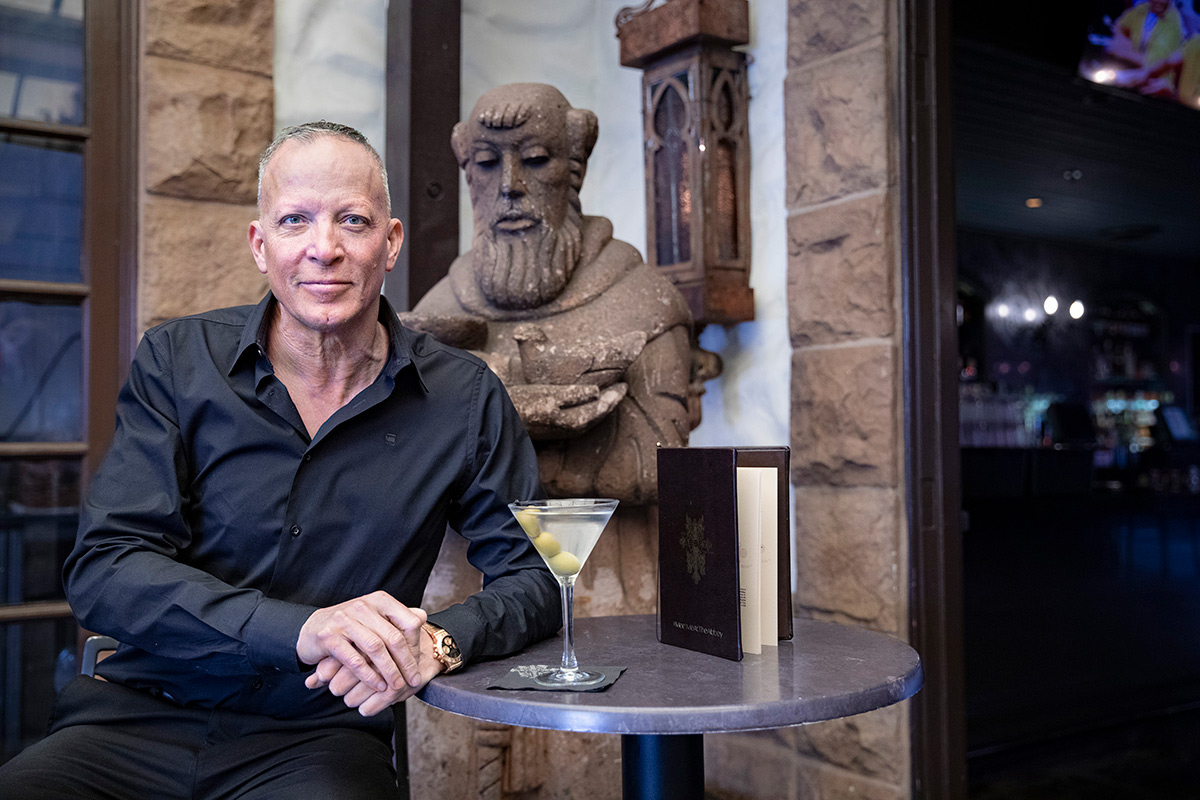
I was finishing my degree in hotel restaurant management at University of Nevada, Las Vegas, when I realized I was holding something back in my life. I came to West Hollywood on a weekend, and I experienced my first gay bar here, which was the Mother Lode. Then I walked up those famous steps of the Studio One nightclub and saw that I was not the only person who was holding all this back.
All the job offers I got out of college were from Chicago and Boston and so forth. But I really felt I needed to be here in West Hollywood. It was the first city I found myself comfortable in. So I turned down the job offers, which was unpleasant for my parents to hear, as well as for the dean of the university, and I moved here without a job. That was 1981. When I moved here, Santa Monica Boulevard was the gay street, but every bar was behind closed doors. Rage had thick curtain on it. Revolver had a glass block. I struggled without a job but then I waited tables. I maître d’ed. I washed cars. I cleaned homes. I became a stockbroker and then went into banking.
Something happened at the bank one day in 1991. It was the worst day of my life, and I made it best day of my life—that day really encouraged me to go out and open up this little business. I had been studying the business of one of my clients who owned The Living Room coffeehouse on La Brea. I thought I could do a business like that in West Hollywood. And I opened up The Abbey on Robertson. When I opened up the doors of The Abbey, and to this day, my policy was no velvet ropes, no doormen picking who can come in; everyone who walks in—if it be a celebrity or the neighbors across the street—are my VIPs. Everyone’s always welcome. If I’d see an individual at night standing on the sidewalk across from The Abbey and they just couldn’t cross that threshold yet to come into what’s thought of as a gay bar, I’d ask them, “Are you coming in?” If they said, “Oh, I’m waiting for a friend,” I knew that was me years ago. So, I’m like, “Let me buy you a drink while you wait for your friend,” and I’d get them comfortable the same way I became comfortable when I went into that first gay bar.
At first, The Abbey was across the street from where we are now [on Robertson Boulevard] and it was a just a coffeehouse with one espresso machine, like four different cakes, and seven employees. When Starbucks started opening up on every corner, I was like, “This is going to ruin my business,” so I had to take that next leap. So that led me to moving across the street to a bigger space in what was the terra-cotta shop. I loved that the new space had all that outdoor patio space right on the street. I was like, “We don’t need to be hiding behind closed doors any longer. We can be seen.” I started having go-go boys and go-go girls dancing on the patio who could be seen by people driving by.
I saw more coffeehouses coming into the City, so I had to take the next step, which was to put in a full kitchen. I expanded The Abbey four more times. Eventually we got our liquor license and later I opened The Chapel, which is an extension of The Abbey. Today, we’re a bar, a restaurant, and a nightclub. I still have my bakery because that’s how I got started.
When I was starting the business in West Hollywood, I never thought I was going to become so involved in politics. But that happened. When I first opened The Abbey, I went to West Hollywood City Council meetings just to listen. Then after some trips to South Beach, Miami, in the 1990s, I got an idea for The Abbey. In South Beach, there were DJs playing in department stores and I realized music is everything for a business, so I decided I wanted to bring in a DJ to The Abbey. Giving a permit to a restaurant to have a DJ was a first for the City Council, and the City had obviously no idea how to handle this. No idea. I had to speak before the City Council to ask for the permit, and they said, “You’re not a nightclub. You’re not a bar. You’re a restaurant.” It was my very first time speaking before the City Council and my permit got approved. Eventually, I got my liquor and dance licenses, too.
After that, I got more involved in city and national politics. Over the years, The Abbey became the town hall of West Hollywood and the place for senators and congress members to come meet the greater L.A. area gay community. When Hillary Clinton was running for U.S. Senate her first time, her campaign asked if they could do an event at The Abbey. We had a nice interaction together, and for my mom’s seventy-fifth birthday, we went to Washington D.C. and Hillary hosted my mom’s birthday dinner at her house. I think because of what The Abbey has become, I’ve become one of the voices of our community. It’s like The Abbey has become the gay ambassador.
For example, I got a call from Obama’s people. I got invited to the White House and first had a meeting with Michelle Obama. She said, “Tell me what we need to know about what’s going on in your [gay] community. What can we do better?” I told her we needed marriage equality. We planned a fundraiser for President Obama at The Abbey, but it got so big we moved it over to the Beverly Wilshire Hotel. I had a one-on-one with the president, and all of a sudden, the Secret Service came in with my parents, and I was able to say, “Mr. President, here are my parents, Peg and Bob.” So, that goes down as probably one of the best days in my life. And that was all because of The Abbey.
So many great things that have happened at The Abbey. I remember walking into The Abbey early in the morning after we had the Northridge earthquake in 1994, and my bakery case lights were on. I’m like, “Oh, my God, I have power.” I think by seven o’clock in the morning, we had people in their pajamas and their robes wanting to come in because they just wanted to get out of their houses —wondering what was coming next. If people didn’t have money I said, “Don’t worry—just get some coffee.” It was like a place everyone felt safe with each other. Again, that’s West Hollywood. Now, we’re a tour bus attraction. I’ve always said, West Hollywood is a melting pot because you have such a diverse community.
We’ve had dogs named after The Abbey. We’ve had kids named after The Abbey because the parents met here. We’ve had marriages happen because of The Abbey. I met all my friends here. I’m surrounded by amazing staff that has become family. Celebrities come here. I remember I was just getting out of the shower at home, and I got a call from an employee that Elizabeth Taylor—a big supporter of AIDS awareness—walked into The Abbey. I threw clothes on, got here so quick, and I went up and I introduced myself. She said, “Can you sit down and have a drink with me?” That turned into a nice friendship. She would tell me stories about her first charity event for AIDS, when so many hotels and restaurants said no to her when she asked to hold AIDS events there. Her last public sighting before she died was leaving here. She brought a portrait of herself and she’s like, “Would you hang that over your fireplace?”
I said, “Of course, but can I call it the Elizabeth Taylor room?”
She was like, “Would you really?”
A few years ago, Lady Gaga came in on a Sunday dressed in a bra and little panties. She said, “Here’s my phone, would you play this song? It’s going to start playing on the radio tomorrow, but I want to release it here.” I think it was the song “Born This Way.” For The Abbey’s thirtieth anniversary, Lady Gaga’s team and City staff surprised me by closing down Robertson Boulevard and painting the street in front of The Abbey and The Chapel in rainbow colors with the words “Born This Way.” During a brunch I was hosting for friends and family to celebrate the anniversary, I was asked to come out onto the street, and all of a sudden Lady Gaga pulled up in her black SUV to surprise me and congratulate me on thirty years of The Abbey. At the same time, our community celebrated the tenth anniversary of the release of her song, “Born This Way.”
West Hollywood city staff work very, very closely with people who want to invest into a new business or hold events in the City. When I wanted to bring in Bottega Louie to West Hollywood, my first call was to the City manager. Within three days, I had a City department head meeting with my partners, and staff was like, “Yeah, this could happen.” In the City of Los Angeles, it would take us probably four or six months to set up a meeting.
Another thing that the City is so great about is making people feel so safe. The morning of the mass shooting against the LGBTQ+ community at the Pulse nightclub in Orlando, Florida, one of the West Hollywood sheriffs called me and said, “Can we meet for a quick meeting?” It was Gay Pride weekend, and everyone was so emotional and scared something could happen in West Hollywood. It was the first time we saw SWAT vehicles going up and down Santa Monica Boulevard. I think West Hollywood became the safest place to be that weekend. It was one of the worst days in America, one of the worst days for our community, but it brought our community even closer and more protected. After the Pulse incident, I decided to bring in an armed guard to The Abbey, but I didn’t want to put that fear into people, so I didn’t talk about it. After that, I got a most beautiful email saying, “Thank you for taking that extra step to make sure that we feel safe at The Abbey.”
The City is definitely changing. Like a business—you always have to keep up with the times. I remember sitting down with some of the councilmembers saying we can’t let those big entertainment industry events—like the Elton John [AIDS] Foundation Academy Awards [Viewing] Party—go to other cities. The City has done a great job of keeping them here. West Hollywood is creative, energetic, a leader in so many ways for new policies. When the Council saw how marijuana impacted so many lives medically, they legalized medical marijuana dispensaries. When traffic got so bad near The Abbey, the City decided to put its first rideshare stop in front of The Abbey and we became the number one Lyft and Uber pick-up and drop-off spot in Los Angeles County.
What surprises me most about how the City has changed is that there’s definitely a lot more mixed-use buildings—retail with apartments. But with all the changes, West Hollywood still has that warmth and charm. I’ll be in Pavilion’s grocery shopping and if I want to run in for five things, I’m walking out forty-five minutes later because everyone’s talking to each other. And that’s the charm of it. That’s West Hollywood. Right? If you go into a restaurant here, it’s the same thing. The City offers a sense of community that people need. It’s like one big fraternity, one big sorority. Everyone kind of knows each other in a way. It’s really charming. I hope the City continues on the path it started right after Cityhood and focuses on the needs of the LGBTQ+ community and other West Hollywood residents.
I hope I had an impact in our community—so people felt they could be who they are and be proud of it. I hope I created an environment where people feel safe, where everyone’s always accepted. To this day, I’ll look across the dance floor and see people having a good time and laughing and meeting new friends. And I love that. When you see my clientele for the evening, you’ll see everyone from all mixes, all ages, gay, lesbian, straight, transgender. I love that everyone’s here. I still get some customers who say The Abbey’s become so straight. And I say, “I’ve accomplished what we wanted then—everyone feels welcome at The Abbey.”
West Hollywood has changed me. What I’ve learned here is that you have opportunity. I think West Hollywood provides that opportunity not only for business but if people are coming to be an actor or whatever their dream is, I think the City offers so much support to make that dream real. I feel so proud that I found a dream and I actually succeeded because of the support of our community, because of West Hollywood City Hall, because of our customers. I sold The Abbey in 2024 and am thrilled that the new owner is committed to continuing The Abbey’s tradition of everyone being welcome.

