
Alan Viterbi
“We were all young at heart,
and we all saw a huge canvas to paint.”
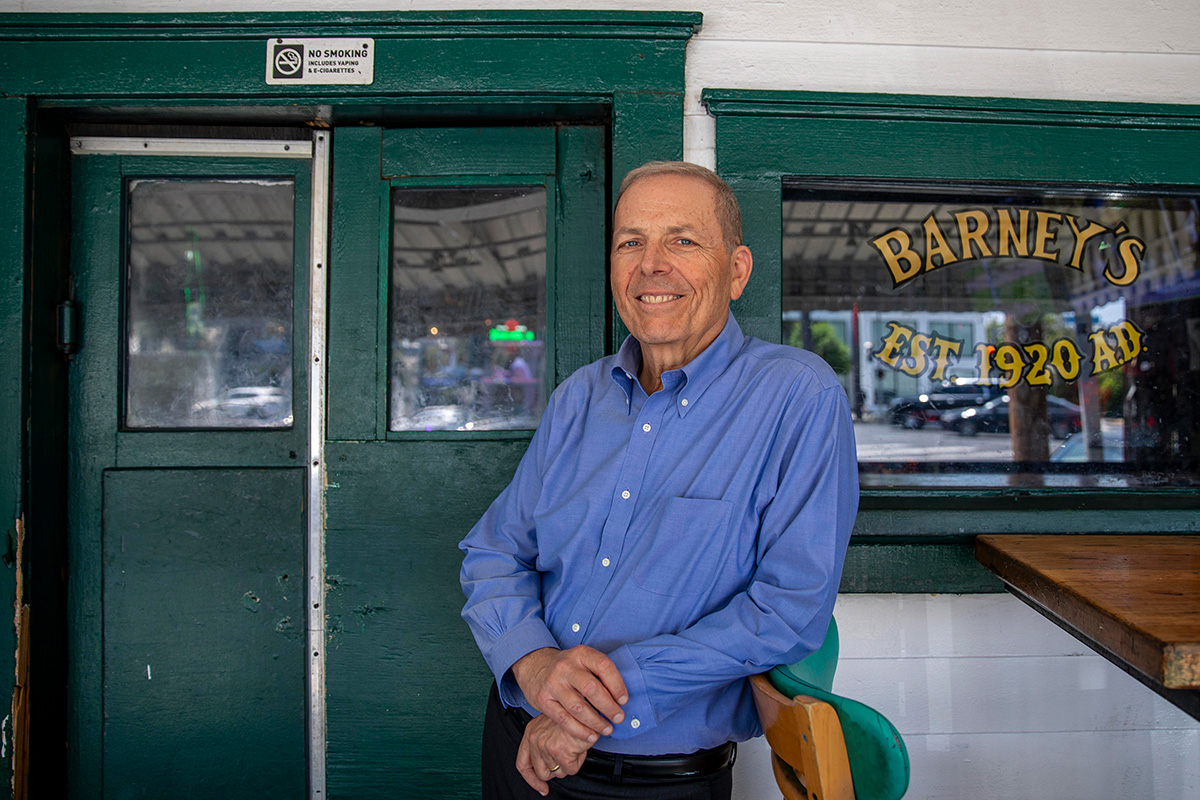
I had just moved to West Hollywood from the westside of Los Angeles when this little unincorporated area of Los Angeles County was in the midst of this amazing conversation about civics, about control by the people. It was just a natural thing for me to get involved with the incorporation effort because I had just finished a Coro Foundation training program in public affairs and I’d been involved in Democratic politics. So in 1984, I joined the West Hollywood Incorporation Committee (WHIC), the group that spearheaded the effort to incorporate West Hollywood at that time.
By the time I joined WHIC, they had already started the whole cumbersome process with the Local Agency Formation Commission (LAFCO), the state-mandated agency that reviews and recommends cityhood proposals. If WHIC members hadn’t been willing to work at it for an extended period of time, Cityhood never would've happened.
But WHIC was a zoo. There were a lot of people with different agendas, but it brought together people who otherwise might never have been sitting around the same table. There were homeowners wanting to stop development; activists from the gay community who saw incorporation as an opportunity to actually change the discourse around gay identity in the American imagination, and to have an honest conversation about the AIDS crisis. The Coalition for Economic Survival (CES) joined WHIC because they were concerned about very real economic issues, like rent control. One of the biggest reasons I wanted Cityhood was that we could have our own rent control law as a way of maintaining a quality of life, a sense of community, for thousands of senior citizens who had lived here for decades. Without rent control, that community would have imploded.
Everybody on WHIC played different roles. Longtime West Hollywood resident Bud Siegel helped to demonstrate we’d be fiscally viable as a city. I give wide credit to CES members [many who weren’t part of WHIC] for doing the everyday hard work to get us through the LAFCO process, like getting documentation together for LAFCO and showing up at their meetings. As I recall, the Los Angeles County Board of Supervisors did all sorts of maneuvers to try and cause our Cityhood efforts to fail.
The Board of Supervisors set the Cityhood vote for the November 1984 General Election ballot. Along with voting for president and everything from State Assembly and Community College Board, West Hollywood voters would have to vote on five people to serve on the City Council if incorporation passed. I ended up throwing my hat into the ring for City Council and became one of forty candidates to run. I wasn't planning on running for public office at twenty-two years old—I had thought I would someday—but incorporation was happening and my friends convinced me to run. Thirty-nine other candidates ran, too. Imagine a political campaign where, in a 1.9 square mile area, forty candidates were precinct walking. Well, not all of them walked, but I spent four to eight hours a day knocking on people's doors. (It was way better than a gym membership if you wanted to get in shape.) Once people actually met a candidate and got to talking about issues, they usually ended up wanting Cityhood, and hopefully, wanting that candidate as one of their councilmembers.
One of my favorite stories from my campaign was when my mom, a Holocaust survivor, was walking precincts to get people to vote for me. One woman invites my mom in for a cup of coffee, having no idea who my mom is. After chatting for about an hour in their heavy accents from different parts of Eastern Europe, the woman says to my mom, “Why did you knock on my door?”
My mom says, ”My son's running for West Hollywood City Council,” and the woman answers, “That's very nice, but my son takes my ballot and decides how to vote for me.” After all that, my mom didn’t even get the vote.
An interesting thing hit me when I was on the campaign trail. I saw a Los Angeles County firetruck and a City of Los Angeles firetruck at an apartment building. They both had arrived in response to the same emergency call, but instead of rushing into the building to save someone who had a heart attack, the firefighters were debating whose jurisdiction it was. It was really powerful to me that there were complicated intergovernmental issues to work on if Cityhood won.
After precinct walking all day, I’d go at night to campaign at the gay bars. People don't go to gay bars to be able to meet politicians, so the first time I walked into a gay bar, I was really uncomfortable, but I put on my best smile and I started walking up to people. One guy said to me, “What are you doing here, aren't you a breeder?” It dawned on me that he meant he knew I was a straight man—a fish out of water. I had met Valerie Terrigno early in the campaign, and she often went with me to the bars. She was young and energetic, and represented the lesbian demographic that really was way underrepresented in the political discourse. I built incredible relationships campaigning at those bars. I met Jonathan Ahearn, who was our beloved first city treasurer, and we became friends. I think campaigning in the gay bars broke down stereotypes because the rumor in the gay community, at the time, was that I was homophobic because I was an Orthodox Jew. I treasure those conversations because they changed perceptions in the gay community about observant Jews like me who didn’t work on the Sabbath and kept kosher. And I grew as a political thinker about how to work with different communities that have shared values but also have very specific individual objectives. I think this was one of the most powerful things for me in the early years of the West Hollywood City Council.
The night Cityhood passed was a very empowering moment. On one hand, conservative President Ronald Reagan won reelection by a landslide. On the other hand, two-thirds of the people in West Hollywood elected five progressive councilmembers. I think I was the second to the top vote-getter in the City Council race—which my father was sure I’d lose—for several reasons: I sent out potholders with my name on them; put out mailers with endorsements from Democratic elected leaders, like Pat Brown, who to every one of those West Hollywood senior citizens was the beloved former governor of California; and I was very public about my Jewish identity. In 1984 West Hollywood was a majority-Jewish city, largely because of the seniors who viewed me as a grandson. At the end of each day, my cheeks hurt because the grandmas pinched them so much.
I also did so well in the election because I got CES’s endorsement, for which I was very grateful because they were the best-organized group in the community. To this day, I can’t say why I got CES's endorsement, but we more or less agreed on rent control and wanted the City Council to fund social services. As an insult, one of their members did call me a Menshevik [a moderate faction of the Russian Social-Democratic Workers’ Party]. I was kind of proud to be called that.
While the Cityhood movement was a magical moment in which you could be just an everyday person and actually do something—and have a voice—the day after we won, we were a city with no established political traditions, no City staff, no unemployment practices for employees, no City calendar, and no insurance policy. But by day 180, we had those things in place. The City Council agreed on ninety-five percent of the issues—we ranged from Menshevik to Bolshevik. We were all young at heart, and we all saw a huge canvas to paint. It felt like we were in a moment where we could do things that actually could shape a national discourse, that were radically countercultural at the time. Those weren’t necessarily the issues that mattered most on a day-to-day basis to residents, but in their bigger identities, they mattered a lot.
We talked about AIDS publicly and factually. We talked about women’s rights. We provided health insurance to domestic partners of our employees, which was difficult at first because insurance companies thought we’d run up million-dollar bills because everyone would have AIDS. Once the Walt Disney Company wanted domestic partner insurance for their employees, the insurance companies had to cave into us or they might lose Disney as a client. I think our domestic partnership ordinance was a building block to marriage equality in this country. We saw many things not necessarily gay issues or Jewish issues but as human rights issues, like making it illegal to discriminate against somebody on the basis of religious observance. We were the first city to require that toy guns sold had orange caps on them. Today, there isn't a toy gun sold without them, and that has saved countless lives.
None of us on the City Council wanted to create our own police department, but we had issues with the Los Angeles County Sheriff’s Department because they had a policy against hiring gay and lesbian deputies who were out. I decided that as a straight councilmember, I should be the one to raise the issue publicly. I had many heated conversations with Sheriff Sherman Block and let him know that if he didn’t change the policy, we would end his very lucrative contract with us. He ended up changing the policy for all L.A. County.
Some of the things we did were silly and naïve. When it came time to adopt a city calendar, I said, “If we're going to give our employees Christmas off in a city where fifty-five percent of the residents are Jewish, we should probably give them Yom Kippur off too.” We added Yom Kippur to the official City calendar that night and shortly after, we got this letter from the ACLU and the American Jewish Congress, threatening to take us to federal court for violating separation of church and state. At a subsequent City Council meeting, about 11 p.m. at night, the City Council went into closed session to discuss the threats. Even though we thought we were in the right, we all agreed that fighting this in court was a really poor use of public resources, so we removed all religious holidays from our city calendar. And City Hall stayed open on Christmas Day.
When we started funding social services, our acting City Manager, Fred Bien, said to us, “Cities don’t do that.”
And I said, “This city isn't another city and we're going to do this.”
After I talked about funding social services for our Russian-speaking immigrants, people came to City Council meetings and said, “Why are you wasting your money on these people, they aren't even citizens yet?”
I responded saying, “Are you Native American, because if you're not, somebody in your family immigrated to this country.” Still, we had to convince some of the well-established social service agencies to accept our funding at first.
They said, “If it'll only be funding for a year, we can't hire up and then lay people off people.”
And I said, “No, no, the City is committed to this in the long term.” Even the Los Angeles LGBT Center was really unsure about taking our money because they weren't accustomed to getting government funding.
Everybody said West Hollywood would fail, not that a city stops being a city once it’s incorporated, but people thought we were a bunch of free-spending liberals who’d bankrupt the City because our high-minded dreams couldn’t be sustained. The Los Angeles Times newspaper trashed us after we adopted a $1 million social services budget, and the [Los Angeles] Herald Examiner newspaper ran headlines mocking us on an almost weekly basis. But the City Council was passionate about proving that we could be a successful experiment in local governance and worked really hard and cleverly to succeed. When we learned that our federal funding dollars would be based on voter registration numbers—since there had never been a city census done—we hired people to go out and register a bunch of new voters. We ended up getting three times more in community block grant money from the federal government than had we not done that. We also understood that if we wanted to keep up our social services funding over the years, we needed to build up our revenues. That’s why I had the idea of setting up an economic development committee.
Since the committee was my idea, I held hearings to listen to the people’s ideas on economic development. CES advocated for a business tax. Businesses said they’d leave the City if we did that, and then we would’ve lost millions in sales tax revenue each per year. The fact that people like Ron Kates, a commercial realtor/developer who opposed Cityhood, realized they could come talk to the City Council and be listened to, made a big difference in keeping businesses, and revenue, in the City. The recommendation of that committee was to set up the West Hollywood Marketing Corporation. That was my baby on the City Council.
In late 1986, I started really sitting down and saying, “So, what am I going to do with my life?” I was running the regional office of a national Jewish women's organization, ORT, and I was on the City Council. Both were great experiences. But I decided that biggest impact I was going to have in this world was on the children that I hoped I was going to have and raise. So at the eleventh hour before I had to file for re-election in April 1988, I announced that I wasn’t going to run and my City Council deputy, Paul Koretz, would run instead. I feel enormously proud that while I was on the City Council, we achieved beyond what we could've envisioned or dreamed. I am proud of the fact that we had a $26 million surplus in the bank and a portfolio of CDs across virtually every bank in the country. I had hoped we would build more senior housing. But when you have a lot of dreams, and they're all big and bold, not all of them will come fully to fruition.

