
*Indicates West Hollywood was the
first city in the nation to enact this change.
The unincorporated town of Sherman changes its name to West Hollywood.
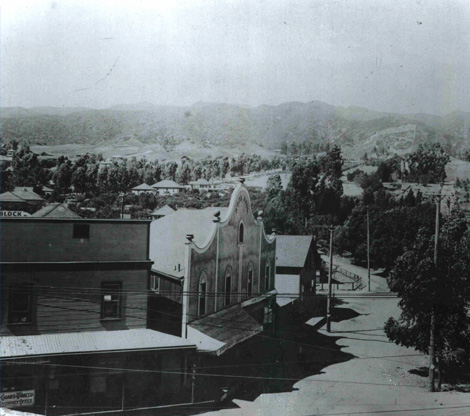
West Hollywood residents unsuccessfully try to incorporate as a city.
Speculators begin buying rental units across Los Angeles County, leading to massive rent increases, evictions, and condo conversions; in response, the Coalition for Economic Survival (CES) begins organizing renters to fight for local rent control laws.
Proposition 13 passes in California, sparking outrage among renters who are hit with rent increases despite landlords’ promises of rent rollbacks. CES begins efforts for L.A. County rent control.
The Los Angeles County Board of Supervisors passes a five-year rent stabilization ordinance for unincorporated areas of L.A. County, which includes West Hollywood.
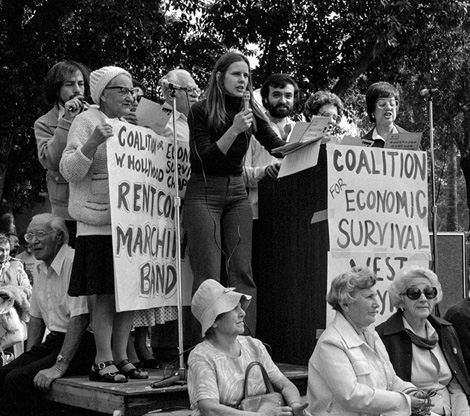
In anticipation of the phase-out of county rent control, CES begins organizing to qualify a resident-sponsored ballot measure, Proposition M, to establish a permanent county ordinance.

Ron Stone, known as the “Father of Cityhood,” forms the West Hollywood Incorporated Committee (WHIC) to explore the establishment of West Hollywood as an independent city.
Proposition M fails, but wins overwhelmingly in West Hollywood; Soon thereafter, CES joins WHIC’s efforts, aiming to establish local rent control through Cityhood.
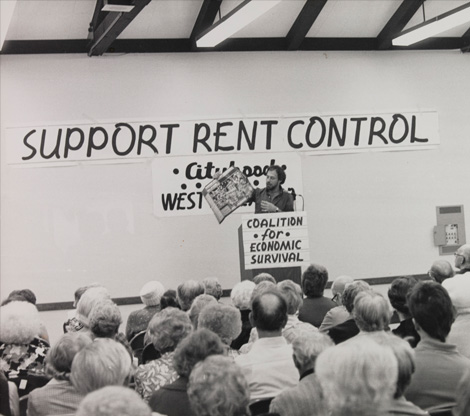
West Hollywood residents launch a signature-gathering campaign to place Cityhood on the ballot in time for the November 6, 1984, general election ballot.
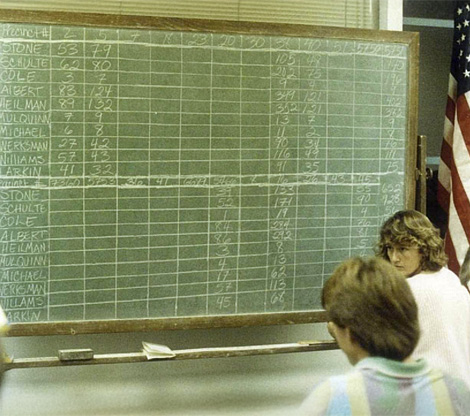
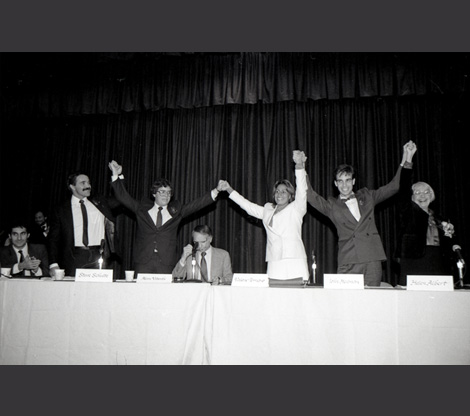
Cityhood passes with nearly sixty-seven percent of the vote: 10,248 residents vote for Cityhood, and 5,017 vote against it. Simultaneously, residents elect a five-person City Council with the nation’s first gay-majority: Valerie Terrigno (6,617 votes), Alan Viterbi (5,581 votes), John Heilman (4,490 votes), Helen Albert (4,328 votes), and Steve Schulte (4,264 votes). Terrigno becomes the first lesbian mayor in the country.
The City Council holds its first meeting in Plummer Park’s Fiesta Hall, passing three ordinances: a moratorium on rent increases; a rent rollback to August 1984 rates; and the prohibition of employment discrimination based on sexual orientation.*
The City Council bans smoking in council chambers.*
The City Council bans discrimination in employment based on religious beliefs.
Mayor Terrigno and Councilmember Viterbi take down the offensive “FAGOTS — STAY OUT” [sic] sign displayed prominently inside Barney’s Beanery, ending a decades-old battle to remove it.
![Mayor Terrigno and Councilmember Viterbi take down the offensive “FAGOTS — STAY OUT” [sic] sign displayed prominently inside Barney’s Beanery, ending a decades-old battle to remove it.](https://cdn.prod.website-files.com/6898c4f539547da4d4c609fe/691150568f82ed4ebb9931ac_Valerie_Barneys.jpg)
The City Council creates a Domestic Partnership Registry for unmarried couples and long-term roommates, granting jail and hospital visitation rights to all those registered. Partners of City employees receive health insurance and other benefits. The ordinance is amended in 1996 to require contractors, vendors, and franchises to provide domestic partnership benefits as a condition of contracts with the City.
The City Council holds the first rent control hearing to begin crafting a rent stabilization law.
The City Council boycotts apartheid South Africa, banning investments in banks, savings and loans, and other entities, as well as prohibiting purchases from companies tied to the country.
Heilman replaces Terrigno as mayor in a 5–0 vote.
The City Council prohibits discrimination against people with AIDS in employment, housing, business, city services and facilities, and educational institutions.*
The City Council votes to keep City Hall open on Christmas Day, December 25th.
A federal grand jury indicts Terrigno for embezzlement of funds from a nonprofit she ran.
The City Council bans smoking in public spaces and workplaces.*
Former Mayor Terrigno is convicted of embezzlement.
Planning Commission Abbe Land wins in a landslide over millionaire disco owner Gene La Pietra in a special election to fill Terrigno’s seat.
The nonprofit West Hollywood Community Housing Corporation is established, following a blueprint policy developed by students from the UCLA School of Urban Planning.
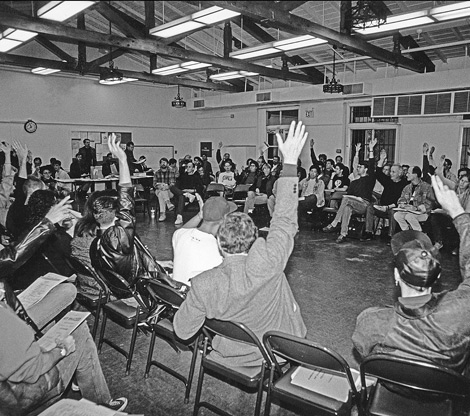
ACT UP/LA forms and begins regular meetings in Plummer Park’s Great Hall to organize actions demanding that the federal government fund AIDS research and healthcare.
The City Council bans the possession and sale of assault weapons.*
West Hollywood Library opens a comprehensive AIDS Information Center to improve public awareness about the epidemic.
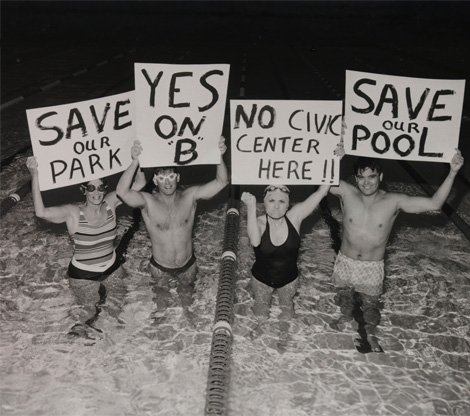
Voters pass Measure B, the resident-led Save Our Parks ballot initiative, prohibiting the building of a civic center in West Hollywood Park.
The City Council bans Styrofoam food packaging.*
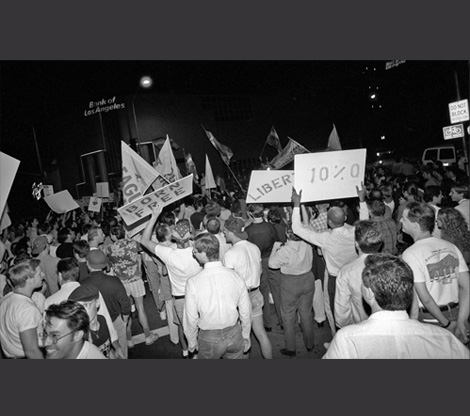
In response to California Governor Pete Wilson’s veto of Assembly Bill 101, a proposed state ban on workplace discrimination based on sexual orientation, thousands of protesters begin a three-week march down Santa Monica Boulevard.
The City Council declares West Hollywood a pro-choice city.*
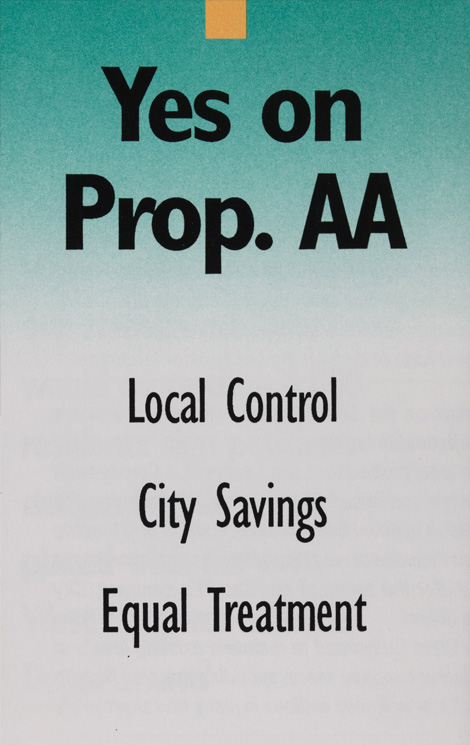
The resident-led Save Our Sheriff coalition defeats the resident-sponsored Proposition AA to establish a city-run police department.
West Hollywood launches a three-day display of the AIDS Memorial Quilt.
California State Legislature passes the Costa-Hawkins Rental Housing Act, upending strong rent control laws in cities such as West Hollywood by allowing unlimited rent increases on a unit once a tenant moves out.
The City Council bans the sale and use of Saturday night special handguns.*
The City Council boycotts apartheid South Africa, banning investments in banks, savings and loans, and other entities, as well as prohibiting purchases from companies tied to the country.
The City Council holds the first rent control hearing to begin crafting a rent stabilization law.
The City Council boycotts apartheid South Africa, banning investments in banks, savings and loans, and other entities, as well as prohibiting purchases from companies tied to the country.
Ron Stone, known as the “Father of Cityhood,” forms the West Hollywood Incorporated Committee (WHIC) to explore the establishment of West Hollywood as an independent city.
Proposition 13 passes in California, sparking outrage among renters who are hit with rent increases despite landlords’ promises of rent rollbacks. CES begins efforts for L.A. County rent control.
The Los Angeles County Board of Supervisors passes a five-year rent stabilization ordinance for unincorporated areas of L.A. County, which include West Hollywood.
In anticipation of the phase-out of county rent control, CES begins organizing to qualify a resident-sponsored ballot measure, Proposition M, to establish a permanent county ordinance.
The unincorporated town of Sherman changes its name to West Hollywood.
West Hollywood residents unsuccess-fully try to incorporate as a city.
Speculators begin buying rental units across Los Angeles County, leading to massive rent increases, evictions, and condo conversions; in response, the Coalition for Economic Survival (CES) begins organizing renters to fight for local rent control laws.