
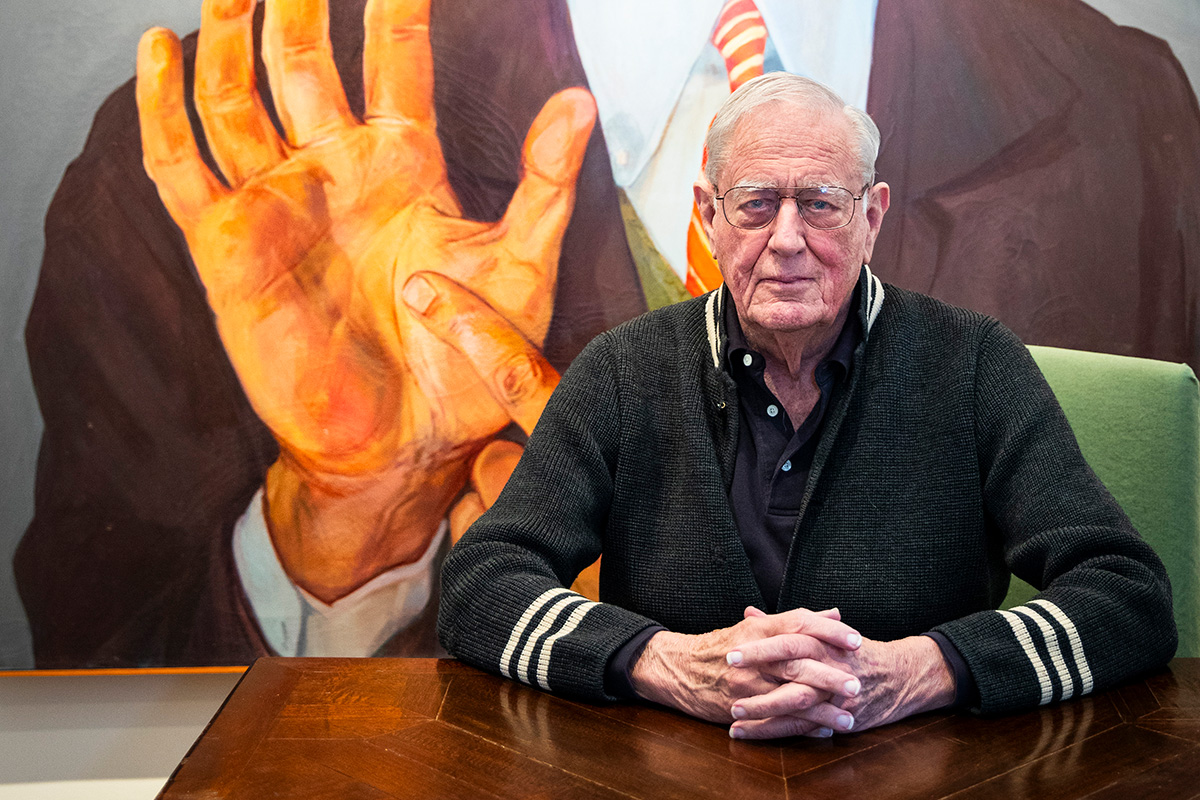
Grafton Tanquary
“I think we’re more of a chopped salad.
We’“I raised my hand to ask a question and ended up becoming president of the West Hollywood landlords’ group, Concerned Citizens.”
I spent my twenties going to the great clubs and restaurants on the Sunset Strip. The Balalaika had a big, beautiful Russian band. Ciro’s had great singers. I remember the night my date lost one of her mom’s borrowed emerald and diamond earrings at the Trocadero. Back then, West Hollywood had the three best restaurants in the greater Los Angeles area—Scandia, the Cock ’n Bull, and La Rue’s. God, those places were beautiful. They had tablecloths on the tables. What happened to tablecloth restaurants? Times change, people change.
After my wife and I got married, we spent six months looking for a home to buy. It was cheaper to buy in West Hollywood than in Beverly Hills, but we would be right next to Beverly Hills and had access to everything that was going on there. Our neighbors were the Montgomery family who owned Sunset Plaza, and Louis L’Amour, the famous cowboy writer. There were actors living up the block, but I don’t remember their names.
When I got divorced in 1966, I moved to the La Fontaine building on Fountain Avenue and Crescent Heights Boulevard. There are a lot of great stories associated with this old, classic building. In one unit lived the owner of the building, Alfredo de la Vega. He was from a wealthy Mexico City family that was thrown out of the country in the 1910 revolution. I remember returning to the apartment one Friday afternoon and there was a lot of flap going around the building. Alfredo had been shot dead. I’m pretty sure he committed suicide—he was actually a closeted gay with AIDS. But because Catholics were forbidden to be buried in the Catholic Church if they committed suicide, his death was announced as a murder.
I became active in West Hollywood community issues during the Cityhood campaign. The idea of rent control was terrifying to me. I owned an apartment building on Sweetzer Avenue and had a lot of questions about what would happen to landlords like me if Cityhood passed. So, I went to an apartment association meeting, raised my hand to ask a question, and ended up becoming president of the West Hollywood landlords’ group, Concerned Citizens. Being president of Concerned Citizens got me involved in everything going on in the City. I probably had less clout than the City thought, but at least as far as they were concerned, I had led a monstrous, do-my-bidding, spend-lots-of-money kind of an organization behind me.
In early days of the City, the City Council meetings were held in Plummer Park. There were maybe a dozen people at one of the first City Council meetings, including me and probably Ruth Williams. I don’t think they had even hired a city clerk yet. All the city management was temporary, but we survived. I don’t know how the hell we did. We did.
People really came out to meetings when the City Council held hearings for the pending rent control law. I remember there would be two lines of people waiting to speak about it. One line represented the renters and the other line represented the landlords. You couldn’t tell the difference between the lines. The people looked the same in each line. They were the same ages. They wore the same clothes. In other words, a lot of the people in both those lines were low-income seniors. The original pitch on rent control was we have got to protect fixed-income senior citizens. But rent control doesn’t just help them. It also helps people like me who live in rent-controlled apartments and could retire early because I invested well. I’d be seriously embarrassed to say how little rent I pay here because of the City’s rent control law. There’s no social justification for this. At the same time, when I was a landlord, the law cost me at least half a million dollars because of rent freezes and vacancy control. That was real money for me. I cut my losses and sold the building. The new owner converted it to condos.
Concerned Citizens sort of died off because things with the rent control issue settled down. Now there is vacancy decontrol. In most buildings with twenty-five units, landlords have enough people turning over in a reasonable period of time, so that they’re okay. There are instances where there are a smaller number of units—maybe four units—and three of them are under rent control, so those people are staying on.
I stayed involved in the City with all kinds of community issues, largely because of the efforts of lifelong resident Ruth Williams. While Ruth was a renters' rights activist and I was the president of the landlord’s group, it was easy for us to find common ground. She was in favor of a nice, good, clean, well-run city, and so was I. We both wanted to keep the Sheriff Department because forming our own police department seemed pretty impractical since we’re a little town. We both wanted to stop the proposal to build a $35-$50 million city hall in the middle of West Hollywood Park. When we wanted to end the problems on Santa Monica Boulevard with prostitutes, we got a bunch of people together to march up and down the street and we chased the prostitutes away. I was lucky because having an organization like Concerned Citizens, with members invested in the City, made it easier to turn out bodies.
I’m very proud of the City. I think we’ve done a remarkable job. The City has become more professional over the years, but sometimes they make mistakes. Why does the City Council take a position on stuff our city has no influence on—like whether or not the US gets out of Syria? That’s not what we hired those guys for. They should be concerned about running our city. And I think it was crazy to give Stormy Daniels the key to the City. Personally, I thought that was very embarrassing. I disagree with Councilmember John Heilman from time to time, but I think he’s done a wonderful job. I think it’s rare to find city councilmembers who are willing to put in the time and effort that he does. I don’t care what the hell the subject is, he was prepared, and that’s not true of a lot of people on the council. I’m a little concerned about the future because I don’t the new people running for office.
West Hollywood has a certain feeling that you don’t find anyplace else. We’re a community with is an eastside and a westside. The westside of the City—and I hate to call it Boystown, but that’s how it’s known—seems wealthier and more sophisticated. Parts of the City have a beautiful charm. I live at two major intersections, but when I walk east of Crescent Heights, especially north on Havenhurst, it is quiet. There are a lot of the apartment buildings hidden behind greenery. If you peek through the bushes and trees, there are some interesting old apartment buildings with courtyards, fountains and antiques. It feels very much like a neighborhood with such warmth. The eastside of the City is developing a sense of community now that there are more restaurants and clubs in that part of town now. You look at what’s going on in Santa Monica Boulevard and Sunset, and there’s a lot of dynamism there. I think that is okay, as long as it doesn’t go too far.
I had my place in the City. I made my small contributions, thanks to Ruth Williams keeping me involved. But, a few years from now, people are going to forget and say, “Who the hell is he?” You know, it was very easy for the first City Council—a bunch of people with no [government] background, no experience—including retired kindergarten teacher Councilmember Helen Albert—to say they wanted to create a city. But it was activists like Ruth Williams who did a lot to keep the City moving in the right direction. Ruth deserves some really great accolades.

