
Karina Samala
“I won ‘Queen of the Universe.’ And that is how Karina was born—in West Hollywood.”
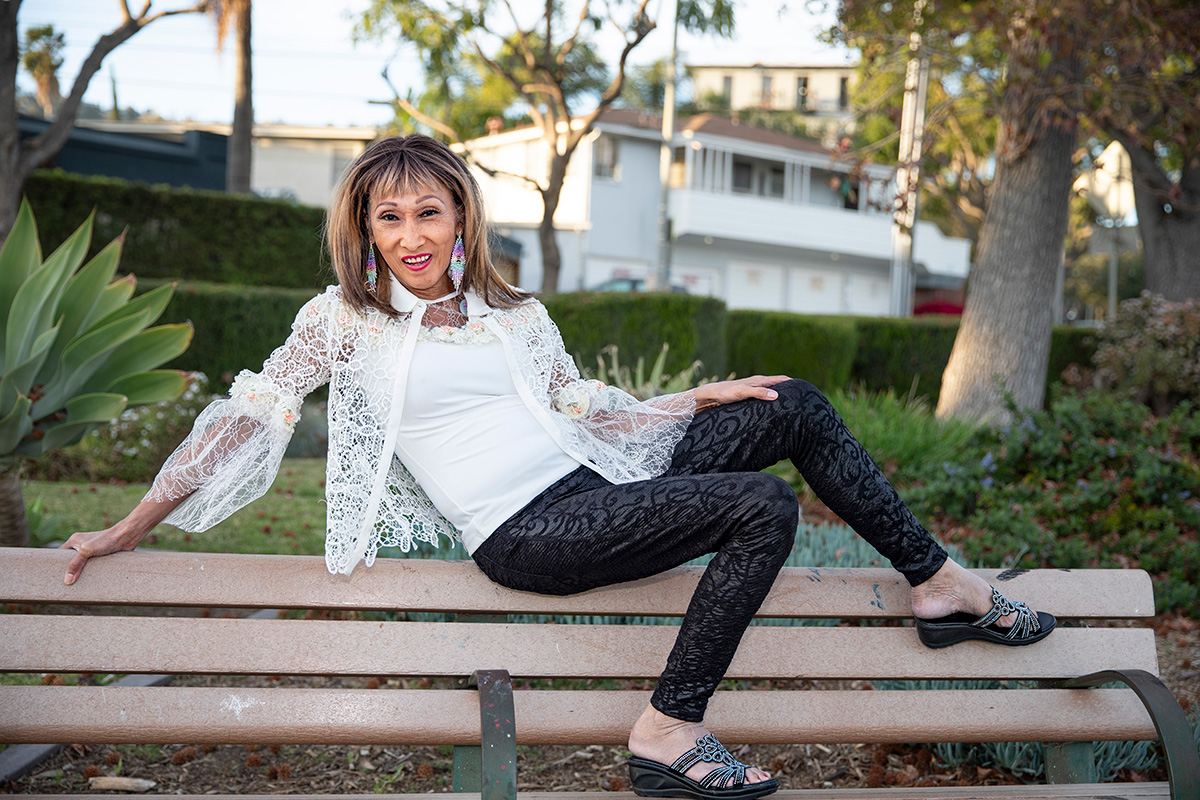
I was born in Manila, Philippines—the only boy among seven sisters. My family was looking forward to finally having a boy, but they dressed me up as a girl in my sisters’ clothes and I’d perform for the family. I always felt different inside. When I transitioned, I felt bad that I took away the only brother my sisters had.
After I got my BS degree in chemical engineering in the Philippines, I joined my family in the United States. In the 1980s, I got a job at the Northrop Grumman facility in the Los Angeles area, but to get the job, I needed a top-level security clearance because the facility dealt with military contracts. I thought if I checked homosexual on the job application, my clearance would be denied. So, I basically had to live a double life. I’d go to work in a suit and tie, but after work, I’d go to gay bars in West Hollywood.
Even though almost no one from the trans community can afford to live in West Hollywood, we became part of the greater West Hollywood community. The gay bars were a safe haven for me—allowing me to be who I wanted to be. They were the only place trans[gender] girls could go to see our friends out in the open—except there were times when transgender women were not allowed in the gay bars. I had bad, bad experiences with the gay men and some lesbians, too. They looked upon us differently. I thought, “Wow, there’s something really wrong with West Hollywood.” And this was just after Cityhood.
But I kept coming to West Hollywood. Every gay bar had a bowling team, and I liked to bowl. I believe that West Hollywood became the center of the trans community because of the bars. The bars were where I met people from the Imperial Court—a nonprofit that raises money to help the LGBTQ community. Meeting them changed my life. From the people in the Imperial Court, I learned about the Closet Ball—a beauty pageant where you come on stage as you are in public, tell your story, then you go backstage and get all made up, and come out dressed as a woman. For a long time, I thought I was just a gay boy who liked the feeling of being onstage as a woman. But I started entering lots of transgender beauty pageants, and in 1991, I won “Queen of the Universe.” After winning, one of my mentors from the Imperial Court said to me, “Why don’t you call yourself ‘Karina,’ the name of an empress.” And that is how Karina was born—in West Hollywood.
Back then, when the bars in West Hollywood closed for the night, everybody went to the Yukon Mining Company Restaurant. That’s where I met Jeffrey Prang, who was mayor of West Hollywood at that time. Jeffrey worked for Sheriff Baca, who had recently formed an LGBT Advisory Council to develop policies addressing the concerns of the LGBT community. Jeffrey assumed I was a transgender woman, even though I hadn’t really transitioned yet, and he asked me to be on the Advisory Council. I thought he only chose me because he needed a “T,” but I joined the Advisory Council because with the Sheriff’s Department policing West Hollywood and disrespecting and harassing transgender women, change had to start by changing law enforcement itself.
As an engineer, I didn’t know how government worked or anything about the policies and the politics of it. Jeffrey became my mentor, and I would meet him for lunch on Saturday or Sunday at the Yukon. I’d ask him a lot of things—about how I could get things done, and the process of all these things. I just wanted to help my community so we would be accepted. West Hollywood residents were complaining about us because some of our girls were in people’s yards earning sex income, and on the streets from night until morning. I don’t blame them for doing that work because most of them were thrown out by their families and have no other way to survive.
My assignment with the Sheriff’s Advisory Council was to create policies for the Department to end transgender discrimination and deal with the problems the larger community had with us out on the streets. I did sensitivity training with the sheriff’s deputies. I’d go with them to the County jail and talk to all the Trans girls. We were very fortunate to have created a section to keep them safe. We also created a policy that when a person was arrested, they had the choice of whether to be booked in a male or female section of the jail, regardless of their genitalia. Because of the work we did with the Sheriff’s Department, and eventually the Los Angeles Police Department (LAPD), law enforcement knows that somebody is watching them and making sure that the trans community is treated as equals and not humiliated.
After thirteen years at Northrop, I said to myself, “I cannot live this lie anymore,” and quit my job. By then, everyone outside of work knew I was trans, and people at work suspected something. I had enough savings from my job at Northrop to spend full time helping the trans community. I started driving around every night, talking to my trans brothers and sisters, taking them to get healthcare, and protecting them from bad partners.
I got more involved with West Hollywood matters when Jeffrey Prang appointed me to the West Hollywood Trans Task Force. At the time, it was part of West Hollywood’s Lesbian and Gay Advisory Board (LGAB). I saw that having the Trans Task Force be part of the LGAB wasn’t working because the trans community had different issues that we needed to tackle—like unemployment, healthcare, and crimes against us. I went to Jeffrey, and I said, “What does it take for us to become an Advisory Board?” He said to me, “Wow, that’s a good idea. Who do you think among the councilmembers will support me on this?” I said to him, “Well, Jeffrey, I think all of them will, because I think they all like me.” I got to know the councilmembers through my work with the Imperial Court and when I was on the Christopher Street West board—the organization that produced the Gay Pride Festival and Parade.
In 2009, the City started the very first Transgender Advisory Board in the entire world. We were all over the news. In 2016, the City of Los Angeles started one too, and the LAPD asked me to work with them. But that didn’t stop some of their officers from pulling me over and threatening to arrest me for loitering when all I was doing was helping the girls on the streets stay safe—giving them condoms and helping them with their boyfriend problems or getting them into the beauty pageants.
Over the years, I was the person the West Hollywood City Council came to when they wanted advice on trans-specific issues, like for job creation and housing issues. If I needed help from the City, I‘d call up a councilmember and ask them to meet me at a place like Basix Food & Bar. And they were all very willing to help. When I needed money quickly for a plaque to commemorate November 20th Transgender Remembrance Day to honor members of the trans community who were killed for being trans, the City Council paid for it. Now, every year we walk with flowers and present them at the plaque near Matthew Shepard Triangle on Crescent and Santa Monica Boulevard.
The support I got from the West Hollywood City Council over the years, I didn't get much from other cities. I make sure the trans community knows this. Recently, the trans community got really upset when the City removed a trans flag crosswalk at San Vicente and Santa Monica Boulevard that activists painted late at night. But since the crosswalk was painted without a permit, the City removed it just like that in the morning. That intersection means a lot to the LGBT community—it’s really a central part of our history because so many demonstrations for LGBT rights were held there—and I think the City should have dealt with the situation better. After that, I told the activists, “Talk to the councilmembers about why they removed it. Attend the council meetings, write to them. Most of them are helping us.” [In 2022, the City Council installed new crosswalks with the transgender flag and added black and brown to the previous rainbow crosswalk.]
I've been doing this trans advocacy work for over twenty-eight years, imagine that. I’m now a consultant to St. John’s Community Health’s Transgender Health Program and I serve on twelve different boards. The trans community in West Hollywood has truly come a long way since I started this work. We are liberated here. We are more respected and better understood. I can tell you that some gay men still give trans women a hard time, but it's changing. We need all the alliances we can get to build these bridges. Even the leather community has changed the way they perceive us, and I have relationships with the Russian-speaking community, who came to West Hollywood from a place where being gay was illegal. I get invited to their events and I've gone to meet them at their houses. But it’s really hard for us to communicate because of the language barrier, so I bring my friend from the Russian Advisory Board to help translate.
Now, I'm the president of the L.A./Hollywood chapter of the Imperial Court, which includes West Hollywood. I started a scholarship fund. One of the girls I helped get off the streets got a scholarship from us to go to law school. She is now a lawyer. Two trans men asked me to be their “mother of the groom.” I feel so good inside, when they come up and say, “Mother Karina, thank you so much, you've helped me a lot.” I want to be remembered for helping my trans community—that I was a mentor, a friend, an advocate, and a voice for the voiceless who cannot speak for themselves.

