
Paul Koretz
“They didn’t seem to think it was inappropriate to meet with the mayor in front of someone who was about to get circumcised.”
I got involved in politics through my parents, who volunteered on Democratic campaigns. I would stuff envelopes for Robert Kennedy’s presidential campaign when I was twelve years old, and by the time Tom Bradley ran for mayor of Los Angeles, when I was thirteen, I walked door-to-door, telling people to vote for him. Talking to voters, I felt like I was voting hundreds of times. Even though I kept getting sucked into working on political campaigns, I thought that after graduating from UCLA, I’d be a science writer. I ended up working on the Cityhood campaign, serving as a council deputy for four years and twelve years as a councilmember. I then went on to the State Assembly and the Los Angeles City Council.
Getting involved in Cityhood through my good friend Alan Viterbi, who I knew from the Bruin Democratic Club at UCLA, changed everything. Alan asked me what I thought about him running for West Hollywood City Council, which was going to be on the ballot with Cityhood. I told him I thought it was a terrible idea even though he had been on the West Hollywood Incorporation Committee. I thought he was only twenty-two years old then, an unknown, and would be running in a field of about forty candidates. When Alan decided to run anyway, I couldn’t just leave him out there because I was a bit of a mentor to him. I worked on the campaign for around three months and literally slept one hour a night for the whole time. I don't know how I survived it. On Election Day, I was supposed to run his Get Out the Vote effort, and I went home first to have breakfast. I put a TV dinner in the oven—this was before microwaves—and fell asleep sitting on the bed. Ten hours later, at nine o’clock at night, a message on my answering machine woke me up. The campaign had been looking for me all day.
Alan and I had an interesting strategy for him to win, which I think turned out to be very sharp: we started campaigning two months before you normally would so that Alan would stand out from the crowd. Alan and I met Valerie Terrigno on the campaign trail, and because she didn’t seem to have a campaign manager, I offered to help run her campaign too. Eventually, Alan and Valerie became endorsed by the Coalition for Economic Survival (CES), along with their three other candidates who were longtime CES members—John Heilman, Doug Routh, and Helen Albert. The last three pieces of campaign mail included all five candidates as the “renters’ rights slate,” but in the weeks before the election, people were getting mail from so many candidates that building managers were taking piles several feet high of mail every day and just throwing them in the trash. Along with Cityhood winning, so did all the CES-endorsed candidates, except for Doug Routh.
After the election, each councilmember hired a council deputy, and I became Alan’s. In the beginning, the entire City staff consisted of only five council deputies, a receptionist, a part-time city attorney, and a temporary city manager—Fred Bien, who I think was seventy-five and came out of retirement to help start up our new city. City Hall was in Plummer Park, Hall B, where we put up a bunch of dividers to separate each council office and the few other staffers. Eventually, we got evicted by L.A. County, which still owned the park at that time, and City Hall moved to where the mid-city Trader Joe’s is today.
In the first days of Cityhood, there was so much pent-up demand by residents that I’d spend most of the eight hours of a nine-to-five workday doing constituent intake from residents calling in for help, and after the switchboard shut down, I’d do whatever else needed to be done. It was insane. I remember one incident where a tenant came home one day and found that he had black carpet, black walls, and black drapes—retaliation for asking his landlord to replace old drapes. We went to Grafton Tanquary, the head of West Hollywood’s landlord group, Concerned Citizens, and said, “We’re either going to pass a rent ordinance where we describe what a landlord’s choices are in carpeting, drapes, paint, and everything else, or you have to get this guy in order, and you've got three days.” Grafton got the guy in order.
Just looking at the first few months after Cityhood, people weren’t sure what to make of this gay, ultraliberal, crazy city. We had a lesbian mayor. We had apartment buildings painted red because the landlords said we were Communists for passing such a strong rent control law. We had a moratorium on development. And businesses didn’t know what to expect from the newly formed City, so Alan and I wanted to show that being progressive didn’t mean you opposed the business community—that not only rightwing Conservatives are probusiness. So, we helped create the West Hollywood Marketing Corporation with Ron Kates to market the new City. That’s how the slogan the Creative City came about. We wanted West Hollywood to become an entertainment center, so we spent a lot of time encouraging restaurants, bars, and nightclubs to come here. Eventually, it felt like they were falling over each other to get into West Hollywood. I think we probably became the most progressive, probusiness city that one could find in those days.
Alan was what you’d call a “Conservadox” Jew—pretty observant— so people in West Hollywood were worried that he was like the Orthodox community, who didn't think well of gays and lesbians. That was completely off the mark. He and I had a good relationship with the rabbi from the Chabad synagogue in West Hollywood, and Alan worked on all the same LGBT, AIDS, and antidiscrimination issues as the other councilmembers did. It was actually Alan, along with Valerie Terrigno, who set in motion the removal of the Barney’s Beanery sign that said, “FAGOTS — STAY OUT” [sic]. Although Barney’s claimed that “fagot” meant a piece of wood because it was spelled with only one “g,” it was obvious that wasn't what it meant. Morris Kight, the iconic gay rights activist who I met in high school, told us he had been protesting over that sign for fifty years, but it took Cityhood to finally get it removed. Aside from that, the two ordinances that Alan and I authored that were really cutting edge were keeping City Hall open on Christmas Day and creating smoking and nonsmoking sections in restaurants, which led to a total smoking ban in public places.
It was 1985 when Alan Viterbi and I thought Christmas and Easter are government holidays, so why not make Yom Kippur—one of the holiest days for Jews—a government holiday too. We were threatened with lawsuits and told, “Christmas is a secular holiday, so that’s why the Supreme Court says it’s okay to close on Christmas.” We said, “If Christmas is going to be a holiday and not Yom Kippur, well, City Hall is going to stay open on December 25.” It didn’t seem that unusual to do this in West Hollywood. Our gay community was pretty heavily Jewish. Our senior community was very heavily Jewish. The Russian community was heavily Jewish. The first year we passed the law, we thought it’d be the quietest day ever at City Hall and we’d catch up on work. Instead, we ended up probably doing twenty-five interviews with the media from all over the world. Last I checked, City Hall was closed on Christmas, but if you wanted to work then, you could.
The smoking ordinance we passed in 1986 was a big step. Eventually, I worked with other cities to get a total smoking ban in public places, which made its way across the country, and to some degree, across the world. I remember on my first trip to China, people didn’t gasp when I told them what we had done for the LGBT community, but they did gasp when I told them about our smoking ban because almost everyone smoked there then. I was there several years later and there were No Smoking signs in public buildings.
I had thought Alan was going to be a rising political star, but instead, working for him made me one. When he decided at the last minute not to run for a second term, he convinced me to run in 1988 instead. When I won, no one saw it coming. I thought I was too shy to be a candidate, but it was just too logical an opportunity not to run. I had done everything that I would ever want to do to position myself to win. Over his first term, Alan had been putting out newsletters and told constituents to call me if they needed help, so almost everyone in the City knew my name. Then, I became known as the council deputy who caught the transient who killed a woman’s dog. And the person who got permit parking off the Sunset Strip because the neighbors were tired of drunk people having sex in their front yards at 2 a.m. when the clubs closed.
It was an easy transition for me to go from council deputy to councilmember because I wasn't really doing anything different. But to do the council job well, I had to leave my full-time job as the first regional director for the California League of Conservation Voters, CLCV. After a while, I had to quit the CLCV job because the council work was so consuming. Councilmembers only got paid a stipend, but I loved the work—although it cost me a lot of money.
As a councilmember, I helped establish the idea that West Hollywood should take a lot of stands that might be extreme at the time, but I figured the rest of society might catch up a little later: on gun control issues, which I had been involved with since the 1970s; on smoking issues; on animal welfare and animal rights issues; and on environmental issues. We could see it with the assault weapon ban. It was significant that West Hollywood was the first city to take that kind of action because we had never had an incident. We just did it because it made sense that nobody needs an assault weapon on the streets of West Hollywood. Beverly Hills then said, “Hey, West Hollywood was right,” and they passed it. Then other cities passed it. Then State Senator David Roberti passed a state law, and U.S. Senator Dianne Feinstein introduced a federal bill, but it expired in 2004. Abbe Land and I did another landmark measure together, which is a ban on Saturday night special handguns. I think that was 1993 or 1994, and the NRA and others challenged us up the legal chain. We prevailed at every level and showed that local actions have broader implications.
I was probably the most extreme councilmember on LGBT and AIDS issues in terms of being willing to take positions and enact legislation. As an example, there was one item that I think everyone else on the council opposed, which was proposed by Michael Weinstein of AIDS Healthcare Los Angeles. He wanted us to make condoms available on the counters of all West Hollywood restaurants, nightclubs, and bars. I thought if there’s anything we can do to curb AIDS deaths, we should be doing it—even if the bar owners and restaurant owners hated being told they had to keep a bowl of condoms at their entrance. This just made sense to me, having had so many people I knew die of AIDS just in the first few years of Cityhood. When I knew over two hundred people who died, I quit counting. The local business community opposed the idea, so it never got implemented.
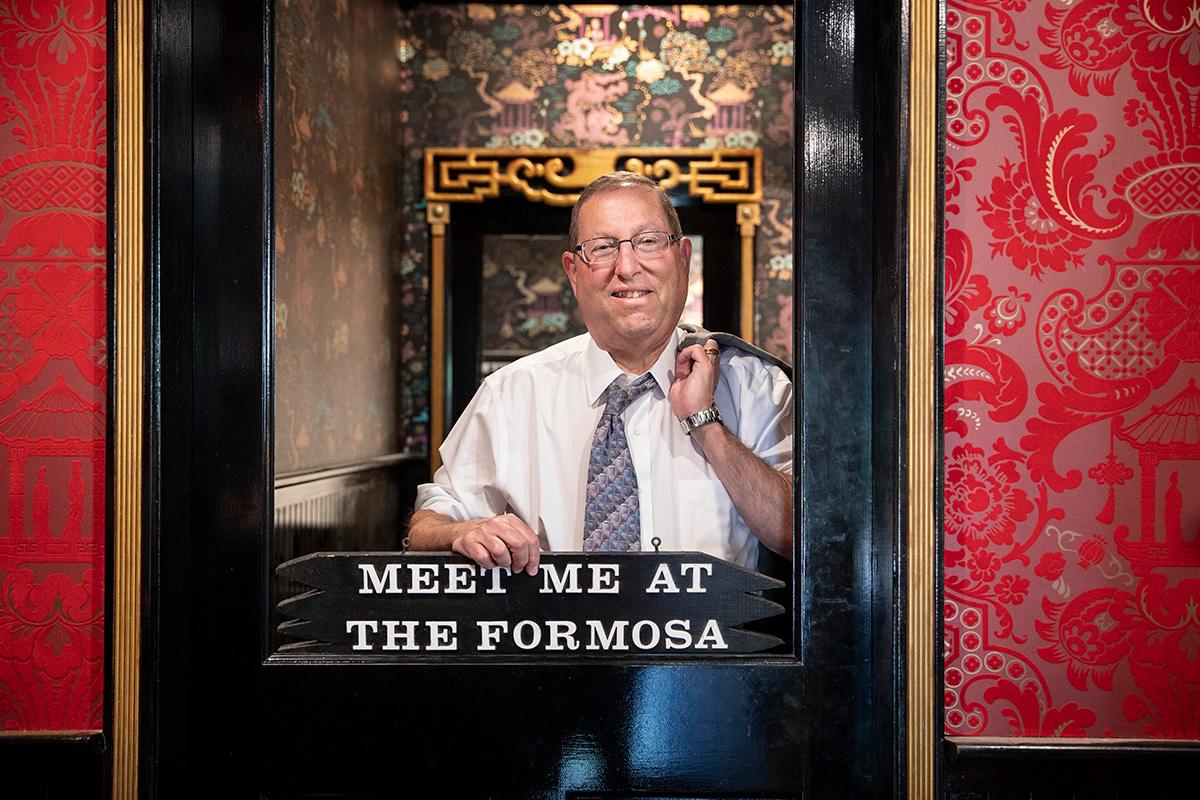
Planning and historic preservation issues were also important to me as a councilmember. After hearing complaints from potential new businesses that the City’s planning process was too bureaucratic, I worked to streamline it so it worked for staff and for the applicants. I supported human scale development—not thirty-story buildings like we had left over from L.A. County. If I thought a project went too far, I’d work with a developer to try to change it. The old Chasen’s restaurant is an example. At first, I thought the proposed project was terrible and I told the developer I was the most pro-development councilmember here, but if I’m going to vote against the project, he shouldn’t even bring it to Council. He came back with a project that today is a successful Bristol Farms Market, but it looks like you’re driving by the old Chasen’s. I also tried to preserve the Formosa Cafe, and today, it’s a historic monument. I also wanted to save Ben Frank’s on Sunset, which was one of the last examples of Googie coffee shop architecture. At the last minute, Mel’s Drive-in bought the property, so it was saved from demolition.
Labor issues were the only issues I felt very alone on during my tenure on City Council. Except for Helen Albert, who had been a union activist and a public school teacher, I was always battling management and my Council colleagues on this stuff. I mean, they supported the Cesar Chavez grape boycott and marched with the janitors in their 1990 strike, but it drove me nuts that they weren’t good on issues relating to City personnel. My strategy was to teach myself a certain amount of labor law so I could argue against our city manager and city attorney. Then I’d find a way to get the labor issue discussed in the public part of the City Council meeting, and not in closed session, because no councilmember back then wanted to be seen as anti-labor.
There are some moments that really stand out from my years on City Council. There was the time I arrived at the Chabad synagogue in the City for a meeting with the rabbi. I got called into another room where the rabbi and nine guys dressed in black are standing around a desk. Lying on the desk is a naked seventeen-year-old guy with a white sheet over him. The desk had been converted to an operating table, and they didn’t seem to think it was inappropriate to meet with the mayor in front of someone who was about to get circumcised. It was my worst nightmare. Another great memory was taking my daughter to the Gay Pride Parade when she was five. As we passed by protestors who had these giant signs that said, “Paul Koretz, you will burn in hell for bringing your daughter,” she looked at me like, “What is their problem?” I was very proud of her. Years later, she said, “What do you mean gay people can't get married?” She couldn’t believe that there was that kind of discrimination because she’d grown up in a city that wasn't having any of that. Today, there are a lot more families living here because West Hollywood is a positive place to live, and people like a city where there isn’t discrimination, where there’s diversity.
I no longer live in West Hollywood. But in my entire life, I have never lived far beyond its borders. As soon as I step into West Hollywood, I still see all these people I know. It’s like being in a place a little like Mayberry.

