
Helen Levin
“After Cityhood, Russian immigrants were
a hot item in West Hollywood.”
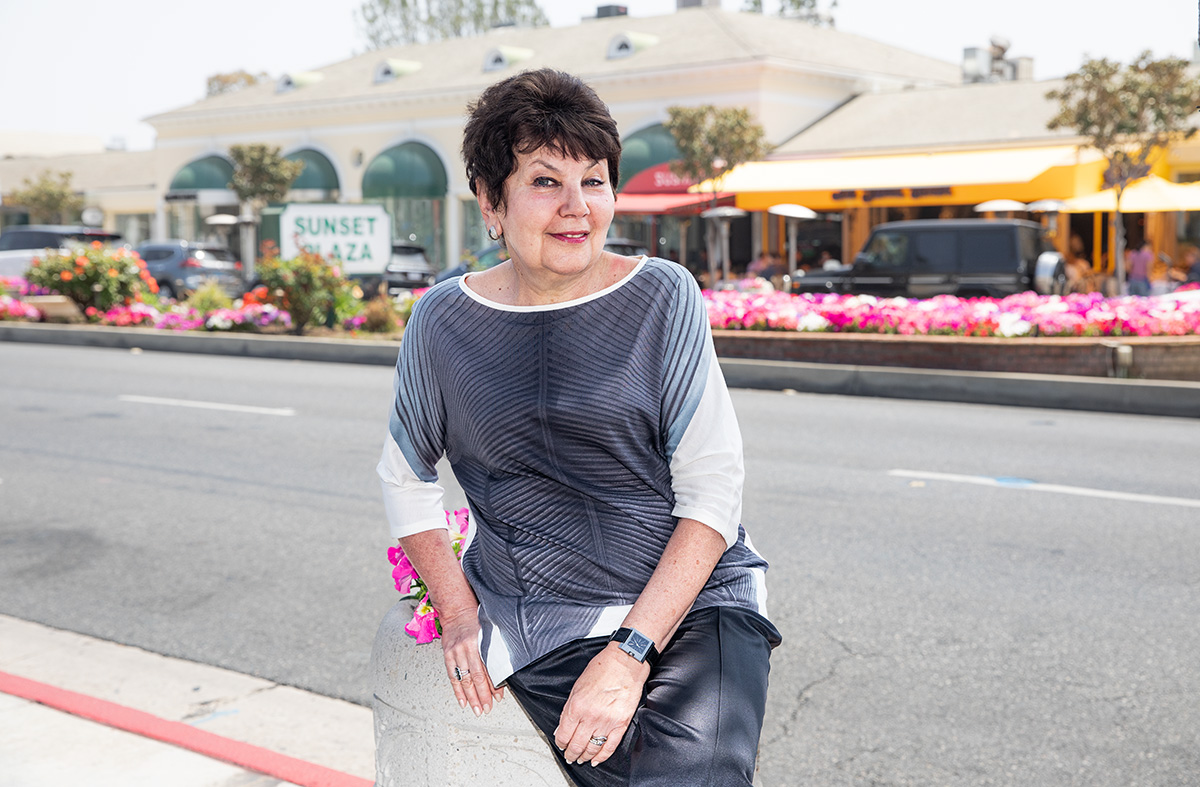
West Hollywood really is a different kind of place. It became such a magnet for Russian-speaking people because after the World Wars, Jewish people from Eastern Europe immigrated to West Hollywood and the Fairfax area. It was where you could reach something by foot or by bus. You could find Russian delis on Santa Monica Boulevard. It was a unique place. And after Cityhood, Russian immigrants were a hot item in West Hollywood. We were in style.
I had been living in the U.S. for about a year when I saw an announcement in a Russian-language newspaper that a new center in West Hollywood was looking for an executive director, and I said, “This is the job for me.” I was never an executive director before, but I spoke Russian and English, and I was working with Russian immigrants at the nonprofit ORT [a Jewish vocational training program] in Los Angeles, so I applied for the job. At that time, I really and truly didn't know any other city in the county of Los Angeles that took such good, everyday care of the Russian-speaking residents.
When I got the job with the City, I didn’t know what I was getting myself into. I didn’t know things. I was saying, “What’s Section 8 [housing], what’s that?” The first years were difficult. Difficult. Difficult. There were a lot of logistics, which I absolutely couldn't understand. There were all those monthly reports to fill out of numbers of West Hollywood residents and non-West Hollywood residents who came to the center. Councilmember John Heilman’s Russian-speaking deputy, Clayton Griffin, who died of AIDS, helped me. He was amazing. He was always joking, naming me “her majesty queen of the Russian-speaking community.”
I thought I would never master this job. The bureaucracy was so overwhelming that I was joking that bureaucracy in the Soviet Union was nothing at all. At the same time, I understood if we wanted the center to be funded by the City, we had to be accountable. I had to explain to Russian-speaking immigrants from Encino and Reseda that small West Hollywood can only help its own residents. And I had to deal with people from different parts of the former Soviet Union—from Moscow, Saint Petersburg, Kyiv. I went in full force and was always honest about delivering to the City what the clients were saying, even if it was something not positive for the ears.
After a while, I was appointed by Los Angeles County Supervisor Zev Yaroslavsky to the County’s Consumer Affairs [Advisory] Commission. That tremendously helped the Russian speakers who were taken advantage of by a fraudulent bill or something because there was someone who spoke their language who could help them. I would call up the person committing the fraud and speak in a not very pleasant tone and say, “I am the director of the West Hollywood Russian Community Center and an L.A. County commissioner,” and the person on the other end of the phone would freeze. I could be very scary when it was needed for the clients.
In those years, there were so many misunderstandings and arguments between the Russian-speaking immigrants and others in the community. Number one was why did Russian speakers stand so close to other people in the supermarkets, and why did they look in other people’s shopping carts? Well, nobody in Russia knew about personal space, and in order to get something good in Russia, we stood in very long lines, very close to one another, and looked to see what other people got. So that’s what they did in West Hollywood. There were instances when they bought cat food or dog food for themselves because they thought it was people food because they couldn't read English, and they saw it in other people’s carts.
There also used to be tensions in the City between the Russian speakers and the gays and lesbians here. In Russia, being gay or lesbian was a crime with seven years imprisonment. Russian speakers didn’t know anything more than that about the LGBTQ+ community. And some members of the gay and lesbian community were calling Russian speakers welfare cheaters, which was also the case a lot of times. The City wanted to minimize those conflicts, so we did a lot of community panel discussions, and they were televised by the City. Slowly but surely, Russian-speaking immigrants saw that people in the LGBTQ+ community were the same as everybody else, and they came to understand that if someone didn’t let you use the dryer or washer first, it wasn’t because they belonged to the LGBTQ+ community; it was for another reason.
There were also problems with the sheriff’s deputies and the Russian-speaking community, because in Russia, when you were stopped by law enforcement, you had to get out of the car and present your papers. But here, you cannot get out of your car when the sheriff’s deputies stop you, so there was that problem, too. So the City’s liaison with the Sheriff’s Department, Nancy Greenstein, and I created a cultural seminar for new sheriff’s deputies to West Hollywood so they could understand that these immigrants weren’t trying to break the law but were doing what they had to do in the former Soviet Union. And we explained to the Russian speakers what the law was here.
I helped organize cultural events in Plummer Park because there are no language barriers in cultural events, and they bring people from all over West Hollywood together. We had Russian ballet groups, concerts with Russian classical music, and the Hanukkah/Christmas festivals, where newly arrived immigrant children were given toys. One year for the festival, my husband, Eugene, and I went to pick up those toys from the Marines, but we couldn’t find anyone to help us. I was fed up, and I stopped in the middle of the warehouse and shouted in my Ukrainian accent, “Is anyone interested in two Russian spies?” The Marines started paying attention to us after that. I was famous from that moment on.
The vast majority of the Russian-speaking community managed to integrate into the West Hollywood community, and they became well adjusted. City management was always more than patient with all the Russian speakers with their accents, with their English mistakes, and with not understanding many customs here. There was a problem at first with Russian-speaking fathers who couldn't find jobs here because of the language barrier. They became depressed and argued with their kids, who learned immediately that it’s a free world here and they can do whatever they want compared to where they came from in the former Soviet Union.
When those kids got older—when they started making money and wanted to buy a house—many of them moved out to the [San Fernando] Valley. That’s how West Hollywood started losing younger generations of Russian speakers. Some of them are moving back now to live near the Sunset Strip, the clubs. Some have started businesses here. Voda Spa, a beautiful place, is owned and run by Russian-speaking immigrants.
I hope that I helped to shape the life of the Russian-speaking community in West Hollywood for the better. And I hope that the Russian Community Center brought the Russian-speaking community closer to the English-speaking community in West Hollywood. I think the people in West Hollywood should be grateful to the City for being so open-minded to all communities here. Other cities can learn from West Hollywood to listen to others and know that everybody can live together. And there is a space for everybody—even in this small city.
I am asking myself all the time how I got to be the executive director of the West Hollywood Russian Community Center. I spent twenty years there, and those years were the most interesting of my life. I loved the job, but after so many years, I decided to leave. I think that I did what I could there—I helped bring people together.

